

The BCP Marketing Pathway: Build Walls, Collect Grains, Push to Private Pool for B2B in China

B2B digital marketing in China takes three steps: build solid owned channels, keep publishing expert content that earns leads, then nurture those leads in a private pool. All of it should start with a full digital footprint audit.
What is the BCP Marketing Pathway?
The BCP Marketing Pathway is Dékuple China's digital marketing method for B2B companies in China. The name comes from its three strategies: Build higher walls, Collect more grains and Push to private pool. The Chinese version, 高筑墙、广积粮、转私强, plays on a famous early-Ming piece of strategic advice from the adviser Zhu Sheng: build high walls, store up grain, and take your time before claiming the crown.
Each step has its own job:
- Build higher walls: strengthen your owned marketing channels
- Collect more grains: publish quality content consistently
- Push to private pool: use brand strength to turn traffic into customers
B2B purchases involve long cycles and several decision-makers, and buyers usually research online long before they talk to sales. BCP first makes the brand credible and easy to verify during that research, then uses content to turn anonymous visitors into identifiable leads, and finally nurtures them in a private pool until they become customers.
Build higher walls: get your owned channels right
The "walls" are the channels a brand controls in China: a Chinese-language website that loads fast in China, a WeChat Official Account, brand information on Baidu, and official accounts on industry platforms and professional social media. Wherever prospects first hear about you, they come to these channels to check.
"Higher" walls means complete, professional and consistent information: products and solutions explained clearly, technical documents and certifications easy to find, and the same company description and contact details on every channel. If the walls are weak, the traffic that content and advertising bring in leaks away.
Collect more grains: content that attracts and captures leads
The "grains" are content. Consistently producing content that is genuinely useful to target customers, such as industry insights, technical articles, application stories, white papers and webinars, works like a magnet: it attracts prospects and steadily strengthens brand recognition.
The key is to deploy content strategically. Some content is open, to build expertise and be found in search. Higher-value content asks for contact details or a follow on the Official Account. Prospects then move step by step from the public sphere into a private space where the brand can identify and follow up with them.
Push to private pool: turn traffic into long-term customers
This step uses brand strength to convert traffic into customers and build long-term relationships in a private domain. In China, that private pool is usually made up of the Official Account, WeCom and a CRM system: sales can follow up one to one, and marketing can send content segmented by industry, role and interest.
B2B customers want to be understood and well served. Offering personalised content and services based on each lead's behaviour and stage, with a sense of exclusivity, is what turns one download or one webinar into an ongoing business relationship.
The starting point: a Digital Footprint (DFP) audit
The BCP framework starts with a Digital Footprint (DFP) analysis. The DFP looks at a brand's digital presence through the eyes of a prospect across the full customer journey. It covers the website, social media, online advertising, search engine rankings and other online assets, and compares them with key competitors.
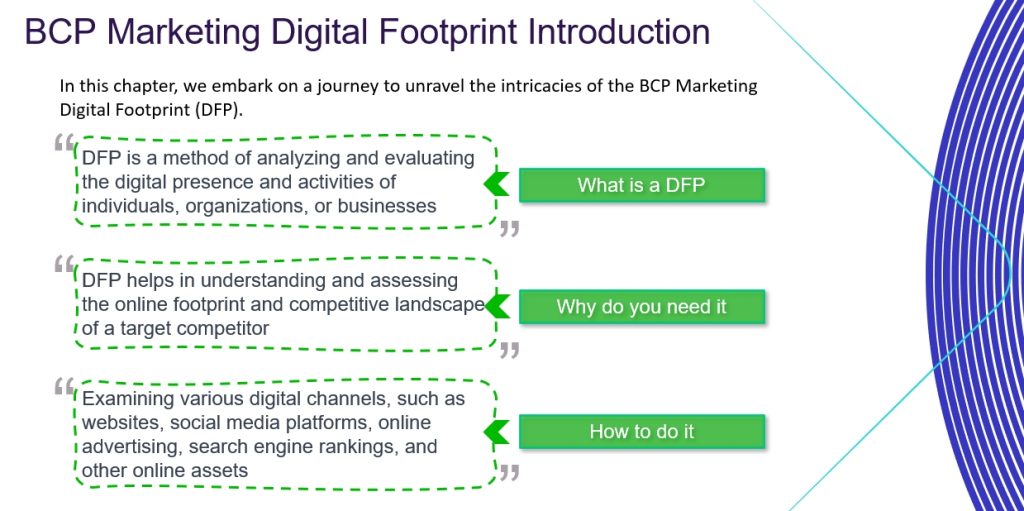
The audit tells a brand three things: where its walls have gaps, whether its content answers target customers' questions, and where the path from traffic to lead breaks. That sets clear priorities for the three BCP steps. BCP is also flexible: it is not a fixed routine, and the emphasis shifts with each brand's audit results and industry. Learn more about our Digital Footprint (DFP) audit.
In 2026, the walls include AI search
More and more buyers now start by asking AI assistants such as DeepSeek, Doubao and Qwen before deciding which suppliers to look at. Building higher walls therefore means more than a good website and accounts: AI needs to be able to find and cite your brand when it answers industry questions.
The good news is that the expert content built up when collecting grains is exactly what AI answers draw on. Content with a clear structure, a clear point of view and sourced data serves human readers and is also easier for AI to use.
FAQ
How is the BCP Marketing Pathway different from traditional B2B lead generation?
Traditional approaches often rely on trade shows, field sales and one-off campaigns, passing leads straight to sales. BCP connects channel building, content and private-pool nurturing into one path: be credible when buyers research, earn leads with content, then nurture them over time, so less traffic is wasted.
Which companies is the BCP Marketing Pathway suited to?
B2B companies with long decision cycles, high order values and a need for expert communication, such as industrial equipment, chemicals and materials, healthcare and professional services. It suits foreign companies that want to build long-term digital lead generation in China.
Where should a company start with BCP?
With a Digital Footprint (DFP) audit. First understand your current presence across Chinese channels and the gap with competitors, then decide whether to fix the walls, the content or private-pool conversion first, rather than investing too early in the weakest link.