

Generative Engine Optimization (GEO)
More buyers now simply ask an AI which supplier to choose. With a four-step method and our own tools, we get your brand understood, cited and recommended by AI, and connect GEO with your SEO, SEM and social.
Why GEO matters now
More and more buyers skip the results pages and simply ask Doubao, DeepSeek, Yuanbao or Qwen which supplier to trust. In September 2026 Doubao alone had 419 million monthly active users, Qwen 158 million and DeepSeek 123 million (QuestMobile), and Gartner forecasts that traditional search engine volume will drop 25% by 2026 as AI chatbots take over queries.
An AI gives one answer, not ten links. Brands that haven't optimised for AI answers run into these problems:
- You're missing from the answer at the moment buyers compare suppliers
- AI describes your brand inaccurately or incompletely, or cites outdated information
- Competitors' content shapes what the AI says and makes the choice for the buyer
- You can't see how your brand is presented across AI platforms
The core of GEO: become a native source AI trusts
When an AI answers a question, it looks for content it considers credible and can quote directly. GEO makes your brand that kind of native source. In practice it comes down to four technical steps, each backed by a tool from our own Brand Pulse suite:
-
01
Pick questions by user intent
- Define what your audience wants: where they are in the decision and how they ask
- Use SEM data to find the keywords that convert
- Starting from those keywords, generate the questions buyers really ask with our Query Master tool
- Check popularity across platforms and keep the most frequent questions
-
02
Build in-depth, high-quality content
- Organise your existing material into a brand knowledge base
- Generate content from that knowledge base with AIGC Generator, so every fact comes from your own material and AI hallucinations are avoided
-
03
Publish across authoritative platforms
- Use Source Rank to see which sources AI cites for each question and which platforms it prefers
- Publish where AI is most likely to trust and cite you, not only on your own website
-
04
Track the data and keep optimising
- Track how your brand's visibility changes across AI platforms with BrandLens, benchmarked against competitors
- A custom dashboard turns the data into regular summaries and insights that decide the next round of work
GEO works best with SEO, SEM and social
GEO doesn't compete with the search, advertising and social work you already do. They share the same content assets and feed each other.
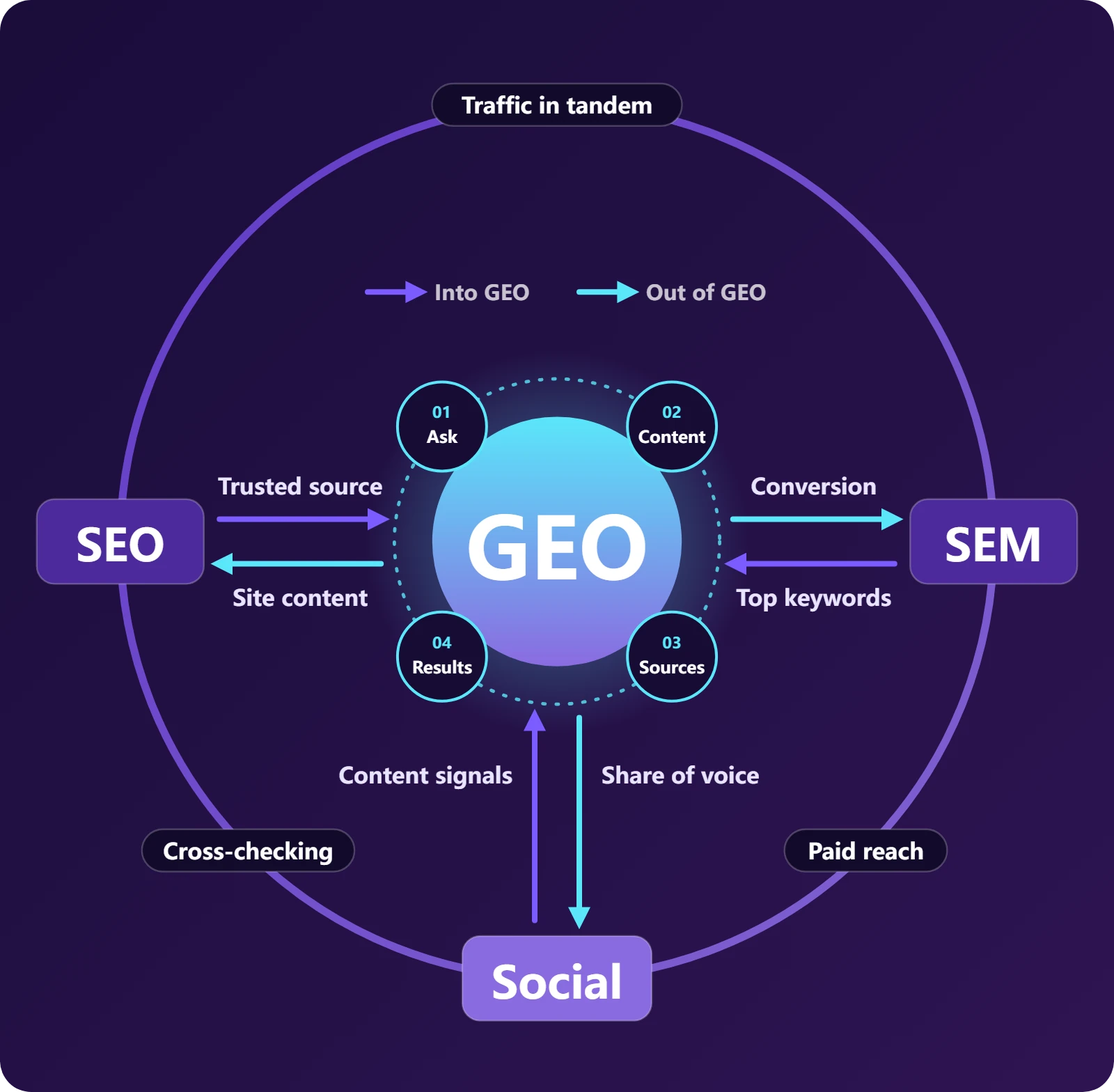
- SEO and GEO: the high-intent questions and authoritative material GEO uncovers feed back into SEO and strengthen your website; your best organic pages in turn become trusted sources that AI cites.
- SEM and GEO: the keywords that convert in SEM are where GEO starts choosing questions; demand created by AI recommendations is then captured by SEM and landing pages.
- Social and GEO: the large volume of user discussion on social platforms gives the GEO knowledge base its core content signals; finished GEO material goes out on social channels to raise share of voice.
- Between the channels: SEO and SEM complement each other's traffic, SEM drives paid reach to social, and social and SEO content cross-check each other.
That's why we usually plan GEO together with SEO and SEM search marketing.
What you get
- AI visibility baseline: how you and your main competitors are mentioned, cited and described on Doubao, DeepSeek, Qwen, Yuanbao and more
- High-intent question list: buyer questions ranked by decision stage and priority
- Brand knowledge base and GEO content: in-depth content that leads with the answer, cites its data and is structured as questions and answers
- Source and publishing plan: which platforms to publish on for each type of question
- Monthly visibility report and custom dashboard: changes in visibility, citations and competitor comparison, with next-step recommendations
Everything is tied to business goals, not just visibility metrics.
Why Dékuple China
- Our own tools, not manual spot checks: Brand Pulse is built in-house and registered with China's National Copyright Administration. It covers the whole process, from choosing questions and writing content to finding sources and tracking results. See Tools.
- We know China's AI ecosystem: Doubao, DeepSeek, Yuanbao and Qwen use different sources and recommendation logic, so we plan platform by platform.
- Search, ads and social in one team: GEO, SEO, SEM and social are planned together, so content assets are made once and reused everywhere.
- An international perspective: as part of Dékuple, a European data marketing group, we know how international brands handle compliance and approvals.
Want to see where you stand? Run our free AI visibility check.
What to have ready before we start
- Business material: product and solution overviews, target industries and buyer personas, your main competitors
- Existing content: website, white papers, case studies, press releases and social accounts, for the brand knowledge base
- Search and ads data (if any): Baidu / Bing SEM accounts, webmaster tools or web analytics
- Goals and budget: the questions you want to be recommended for, timeline and budget range
- Contacts: the marketing owner, plus whoever reviews content
Key Data & Sources
| Data | Value | Source |
|---|---|---|
| Monthly active users of AI-native apps in China (Sept 2026): Doubao / Qwen / DeepSeek / Yuanbao | 419M / 158M / 123M / 37.3M | www.questmobile.com.cn |
| Gartner forecast: drop in traditional search engine volume by 2026 due to AI chatbots | 25% | www.gartner.com |
FAQ
How is GEO different from SEO?
SEO gets you ranked in search results; GEO gets you correctly recognised, cited and recommended when people ask an AI. They share content assets: good SEO pages are trusted sources for AI, and the questions GEO uncovers feed back into SEO.
What is a "native source"?
A source that AI quotes and relies on directly when it answers. To become one, a brand needs in-depth content with cited data that answers real buyer questions, published on platforms the AI trusts.
How long does GEO take to show results?
It depends on your industry and existing content. Changes in mentions or citations on some questions usually appear within weeks of content being published and indexed; a stable place in recommendations takes several months of content and distribution. We report visibility changes monthly.
Which AI platforms do you optimise for?
Mainly China's leading assistants: Doubao, DeepSeek, Yuanbao and Qwen, and international platforms such as ChatGPT when needed. Each uses different sources and preferences, so we track and plan per platform.
How do you measure GEO results?
BrandLens tracks how often you are mentioned on target questions, which sources are cited, how accurately you are described and how you compare with competitors. Combined with website and lead data, it's reported monthly in a custom dashboard.
We already do SEO and SEM. Do we still need GEO?
Yes, and you can start faster. SEM data goes straight into choosing questions, SEO content can be reshaped into a form AI cites easily, and demand created by GEO can be captured by SEM.
Related services
Digital Footprint (DFP) Audit for China
Dékuple China's Digital Footprint (DFP) audit uses a 100-point scoring framework across core channels, content, and search & AI to measure how your brand and its main competitors really show up in China's digital ecosystem — with prioritized recommendations and a pilot plan.
Learn more →Paid Media & Performance Marketing
Dékuple China plans and runs paid media for international brands in China — Baidu, WeChat, Douyin, Xiaohongshu, office-building lift ads and more, chosen by audience — with creative, landing pages and tracking joined up. Through our French headquarters, we also provide media and production resources for campaigns in Europe.
Learn more →SCRM & Marketing Automation in China
Dékuple China helps international brands select, set up and run SCRM (social CRM) in China: we compare vendors against your business needs, build profiles, tags, lead scoring and automated journeys, run the system ourselves first, then train your team to use it — with dashboards that show how people, traffic and content drive leads and conversion.
Learn more →Want to see this service in action?
Whether you are an enterprise seeking a new perspective on the Chinese market, or a professional company looking to improve marketing performance, we provide expert services and insights.
Get in touch