

How to attract Chinese students: planning every touchpoint with the recruitment funnel

Attracting Chinese students is not about posting on one platform. It means designing touchpoints along the funnel: social and search for awareness, website and Q&A content for comparison, and the website and WeChat for applications and enrolment.
China is still the largest source of international students
According to China's Ministry of Education, 703,500 Chinese students went abroad to study in 2019, the most recent annual total the ministry has published. International comparative data cited by Campus France put Chinese outbound students at 1,052,283 in 2022, the largest number from any country.
In France, there were 27,123 Chinese students in 2023-2024, the third-largest group of international students. Demand is there, but so is competition, and schools need a structured approach rather than scattered promotion.
What is the student recruitment funnel?
Choosing a school abroad is a long decision. We split it into five stages: awareness, informing, interest, applying and enrolling. Each stage has fewer people than the one before, but their intent is clearer and the information they need is more specific.
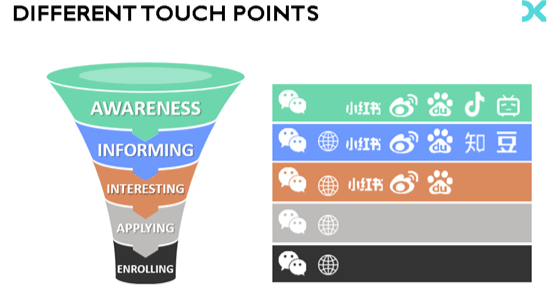
The point of the funnel is that each stage needs different platforms and content. The top has the most touchpoints; the bottom narrows to the website and WeChat, the two channels the school controls.
Top of the funnel: getting noticed
Awareness has the widest set of touchpoints: WeChat, Xiaohongshu, Weibo, Baidu, Douyin and Bilibili. The aim here is not to persuade but to get the school onto the student's radar.
- Campus and city content: video and posts on campus life, the city and students' daily routines help prospects picture themselves there.
- Format by platform: Douyin and WeChat Channels suit short videos and student testimonials, Bilibili suits longer explainers and interviews, and Xiaohongshu suits first-hand experience posts.
- Know the audience first: find out which platforms your target students use and whether they read, listen or watch before deciding where to invest.
Middle of the funnel: supporting research and comparison
In the informing and interest stages, students search and compare. The school website, Zhihu and Douban join the touchpoints, while Baidu and Xiaohongshu stay important. This is where a school makes the shortlist or does not.
- Chinese website: optimise for Baidu with keywords, titles and page structure that match Chinese search habits, and make sure it works well on mobile.
- In-depth content: programme details, career outcomes, interviews with students and faculty, and alumni stories are what students and parents need when comparing. For undergraduates interested in research, present research work as video interviews or podcasts.
- Q&A communities: discussions on Zhihu and Douban shape students' views, so accurate information needs to be there.
Bottom of the funnel: turning interest into applications
At the applying and enrolling stages, touchpoints narrow to WeChat and the school website. Weixin and WeChat had 1.439 billion combined monthly active users in the second quarter of 2026, making it the communication tool nearly every Chinese student and parent uses.
- WeChat Official Account and chat: answer application questions quickly, publish deadlines and interview schedules, and make content easy to share in family groups.
- WeChat search: more users search inside WeChat, so Official Account articles are themselves search results.
- Website application path: Chinese landing pages, a clear application form and email follow-up reduce drop-off at the last step.
What to add in 2026
The funnel has not changed, but the way students find information has. China had 1.30 billion internet users in October 2025, and alongside Baidu and social media, more students now ask AI assistants such as DeepSeek or Doubao which European school to choose for a given subject. Those answers draw on public Chinese-language content, so the website and Q&A content in the middle of the funnel now also decide whether a school appears in AI recommendations.
To plan content and media across the funnel, see our social media management service. For the month-by-month rhythm of each stage, see the Chinese student recruitment cheat sheet.
Key Data & Sources
| Data | Value | Source |
|---|---|---|
| China Ministry of Education: Chinese students going abroad to study in 2019 | 703,500 | http://www.moe.gov.cn/jyb_xwfb/gzdt_gzdt/s5987/202012/t20201214_505447.html |
| Campus France China, citing Campus France Key Figures 2025: Chinese outbound students in 2022 | 1,052,283 | https://campus.faguowenhua.com/wp-content/uploads/2026/05/Invitation-Tournee-dAutomne-Campus-France-Chine-2026.pdf |
| Campus France Key Figures 2025: Chinese students in France, 2023-2024 (third-largest country of origin) | 27,123 | https://www.campusfrance.org/system/files/medias/documents/2025-05/EN_CP_Chiffres_cle%CC%81s_2025.pdf |
| Tencent 2Q2026 results: combined MAU of Weixin and WeChat (30 June 2026) | 1,439 million | https://www.tencent.com/wp-content/uploads/2026/08/Tencent-Announces-2026-Second-Quarter-Results.pdf |
| DataReportal Digital 2026 China: internet users in China, October 2025 | 1.30 billion | https://datareportal.com/reports/digital-2026-china |
FAQ
Which layer of the funnel do schools most often neglect?
Usually the middle. Many schools invest heavily in social content for awareness but lack a Chinese website and in-depth content that support comparison, so students know the school but do not shortlist it.
Do we really need a Chinese website?
At the applying and enrolling stages, touchpoints narrow to WeChat and the website. Without mobile-friendly Chinese pages optimised for Baidu, students lack a reliable source during research and application, and AI assistants have little to cite.
What role do parents play in the funnel?
Parents are often involved throughout and focus on reputation, cost, safety and careers. Make WeChat content easy to share within the family, and address parents' concerns directly in mid-funnel content.