

China's Snack Market Trends: Healthier Snacks, Discount Snack Chains and Online Growth

China's snack market is large but fragmented, and growth comes from healthier products, discount snack chains and online channels. Imported brands are losing their edge to good-value local products and must win young consumers with clear positioning, the right pack sizes and social proof.
A large and fragmented market
A December 2023 report from the USDA Agricultural Trade Office in Beijing estimated that China's snack food sales would exceed USD 66 billion in 2023, up 2.3% year on year. Snacking recovered quickly after the pandemic, helped by the return of social activities.
The market is highly fragmented. Citing Euromonitor, the same report notes that the leader, Mars, holds only about 4% of the market. By category, bakery and puffed products account for more than 40%, nuts and dried fruit for more than 13%, and confectionery for more than 10%.
Fragmentation leaves room for new brands, but it also means no single channel or campaign reaches every consumer.
How do Chinese consumers snack?
In China, snacks meet social and emotional needs as much as hunger: gatherings with friends, sharing at the office, watching series and visiting family during festivals. Fast-paced city life has also made eating a little at any time a habit.
Tastes vary by region. The USDA report says salty is the most popular snack flavour, followed by spicy. Consumers in Guangdong rarely eat spicy food, Beijing and Chengdu combine spicy and salty, and the Shanghai area prefers sweeter flavours.
Needs differ by age as well. Teenagers buy on impulse and care about packaging; people aged 25 to 40 are brand-aware, focused on health and nutrition and less price-sensitive; seniors prefer simple flavours and good value. Young women and consumers with overseas experience are the main buyers of imported snacks.
Healthier snacking: low sugar, high protein, clean labels
Since the pandemic, Chinese consumers have paid much more attention to health. Low-sugar, low-fat, additive-free and preservative-free snacks are gaining ground, and more shoppers read ingredient lists closely and prefer simple formulations.
The USDA report names growth categories including meat and seafood snacks, cheese sticks, protein and snack bars, rice snacks, and nuts, seeds and trail mixes. Meat snacks are especially popular with young people and were expected to exceed 14% of total snack sales in 2023.
This plays to European brands' strengths: clear sourcing, nutrition information and quality standards are exactly the trust signals Chinese consumers look for in healthier snacks.
Channels: discount snack chains and online growth
Snacks are still sold mainly offline. The USDA report estimates that about 80% of snacks go through offline channels, with retail chains taking more than 40% of the total, and snack specialty shops growing fast among young consumers.
Discount snack chains show this most clearly. Busy Ming Group, formed from the Lingshi Hen Mang and Zhao Yiming Snacks chains, reported GMV of RMB 41.1 billion in the first half of 2025 and 16,783 stores at the end of June 2025, and in September 2025 became the first operator in the sector to pass 20,000 stores. These stores win lower-tier cities and young shoppers with low prices, loose weigh-and-pay snacks and very wide ranges, which puts new demands on brands' pricing and pack sizes.
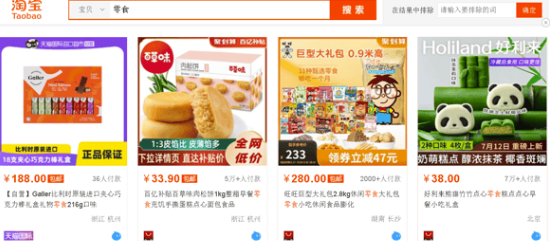
Online is growing too. China's National Bureau of Statistics reports that within online retail sales of physical goods in 2025, food grew 14.5%, well ahead of clothing and household goods. Content commerce platforms such as Douyin have become a key launch ground for new snacks.
Shopping festivals and seasons
Snack sales are seasonal. Autumn and winter are peak months, with festivals such as Double 11 driving stock-up purchases online, and around Chinese New Year snack gift boxes are a staple of family gatherings and visits.
For brands, launches, gift-box design and content spending should be planned around these moments rather than spread evenly across the year.
Opportunities and challenges for imported snack brands
The USDA report notes that imported products still enjoy a good reputation for quality and food safety, but China's food industry has matured. Some local makers now offer products that look and taste like imports at lower prices, and high-end local brands have gained share. Consumers are more cautious, and some retailers have started offering imported products in smaller packs to lower the unit price.
For promotion, the report recommends that new brands build awareness through social media: short product videos on the main platforms, a WeChat official account and genuine user reviews on Xiaohongshu. In 2026 Xiaohongshu is a major place where consumers search for snack recommendations, and AI assistants increasingly draw on that content in their answers.
Dékuple China's social media management and paid media services help snack and food brands build reputation and drive sales on Xiaohongshu, Douyin and WeChat.
Key Data & Sources
FAQ
How big is China's snack market?
A December 2023 USDA report from the Agricultural Trade Office in Beijing estimated 2023 snack sales at more than USD 66 billion. The market is highly fragmented, with the leader holding only about 4%.
Which snack categories are growing fastest?
Health-related categories stand out, including meat snacks, cheese sticks, protein bars, rice snacks and nut and trail mixes. Low sugar, low fat and simple ingredients are the common selling points.
Which channels should imported snack brands prioritise?
Offline is still the core, so discount snack chains and retail chains deserve close evaluation. Online, focus on content commerce such as Douyin and on reviews on Xiaohongshu. Adapt pack sizes and prices to each channel, for example with smaller packs.