
SEO is more than "adding more keywords": how experts and non-experts see it

SEO looks simple but isn't easy. Keywords are a small part: search intent, crawling and rendering, content structure, entities, internal links and schema, third-party authority, and now AI citations decide whether a brand gets seen.
One discipline, two very different views
This graphic has been doing the rounds in marketing circles. On the left is SEO as practitioners see it: GEO, AEO, AI citations, passage ranking, entity signals, server-side rendering, schema markup and more than twenty other topics. On the right is SEO as everyone else sees it: "Just add more keywords."
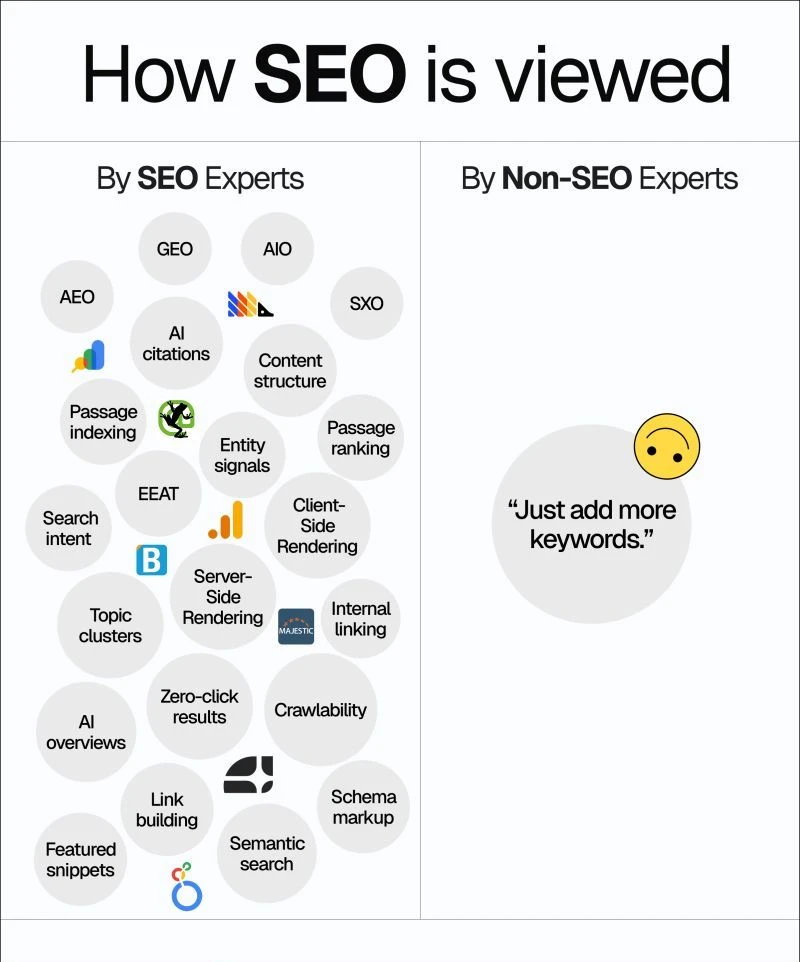
It's funny because it's true. We see the same gap in projects: the brief is to repeat the keyword a few more times, while what actually holds rankings back is that pages aren't crawled properly, or the content doesn't answer what users are really asking.
Simple, but not easy: seven layers beyond keywords
Keywords matter, but they are a small part. To earn search visibility today, a team needs to understand at least:
- Search intent and topic coverage: what the searcher is trying to solve, and whether the content covers the topic fully.
- Crawling, rendering and indexing: can search engines get in, see the main text, and choose to index it.
- Content structure and passage ranking: a single passage can be retrieved and ranked on its own, so each heading and paragraph should make one clear point.
- Entity signals and semantic search: search engines understand relationships between brands, products, people and places, not just matching words.
- Internal linking and schema markup: help search engines read the site's structure and page types, such as articles, FAQs, products and organisations.
- Links, mentions and third-party authority: what others say about you often counts for more than what you say about yourself.
- AI citations, zero-click results and AI Overviews: more questions are answered on the results page or in an AI answer, without a click to the site.
In China: plan for Baidu and AI assistants
The same principles apply in China, on different platforms. A website first has to be crawled and indexed smoothly by Baidu: hosting and load speed, and whether the main text only appears after front-end scripts run, affect results more than keyword density. For sites that rely on client-side rendering, server-side rendering or static pages are usually the safer choice.
At the same time, AI assistants such as Doubao, DeepSeek and Yuanbao are becoming a new place where people ask questions. They cite web and platform content as sources, so whether a brand appears in the answer depends on having clear, credible, structured content they can read and trust. For website SEO and Baidu advertising, see our SEO & SEM search marketing service.
The new layer: from ranking to being cited
Traditional SEO aims for rankings and clicks. AI search adds another goal: being cited and recommended by AI. That is what GEO (generative engine optimization) addresses. It doesn't replace SEO; it builds on it. Pages that can be crawled, clearly structured content, consistent entity information and third-party endorsement make AI more likely to treat you as a trusted source.
To find out how visible your brand is in AI answers today and where to start, see our GEO service.
Three questions for your team
- Can the main text be seen? Open the page source and check that the main copy is in the HTML, not loaded later by scripts.
- Does each page answer one clear question? The title, headings and first paragraph should tell people and machines at a glance what the page solves.
- What are others saying about you? Search your brand and category questions on Baidu and in AI assistants, and see whose content gets cited.
FAQ
Is adding more keywords enough for SEO?
No. Keywords are a small part. Search intent, crawling and rendering, content structure, entities and semantics, internal links and schema, third-party authority and AI citations all affect whether a brand gets seen.
How does GEO relate to SEO?
GEO builds on SEO. SEO gets pages crawled, indexed and ranked; GEO goes further, so the brand is cited and recommended in AI assistants' answers.
What is different about SEO in China?
Baidu is the main search engine, and AI assistants such as Doubao, DeepSeek and Yuanbao also matter. Crawlability, speed and rendering often affect results more than keyword density.
How can we quickly check our SEO basics?
Check that the main text is in the HTML, that each page answers one clear question, and whose content gets cited when you search brand-related questions on Baidu and in AI assistants.