

AI Sources Change Every Month: 100+ B2B Questions on Four Chinese AI Platforms

For the same question, only 13%–39% of the pages an AI cited last month are still cited the next. Qwen doubled its citations per answer; Yuanbao cut overseas sites and added WeChat articles. When an answer cites a brand's website, it recommends that brand 92% of the time.
What we measured
Every brand working on GEO (generative engine optimization) wants to know one thing: are the pages an AI cites fixed, or do they keep changing? And if they change, how fast?
We used GEO monitoring data for one B2B brand to answer this. From September to November 2026 we asked the same set of more than 100 Chinese-language questions on DeepSeek, Doubao, Qwen and Yuanbao every month, and recorded the pages each answer cited and the brands it recommended. That gave tens of thousands of citations over three months.
The questions fall into three types:
- Knowledge (more than half): non-brand questions on specifications, selection and standards, to see whose content AI cites.
- Recommendation (about a third): "which brands do you recommend" questions, to see who AI recommends.
- Brand (about a tenth): comparison and explainer questions that name the brand.
For how we score brands inside AI answers, see Diagnosing AI visibility with BrandLens.
Finding 1: AI replaces most of its sources every month
For the same question on the same platform, we compared the cited URLs in consecutive months to see how many of last month's pages were still in the next month's answer.
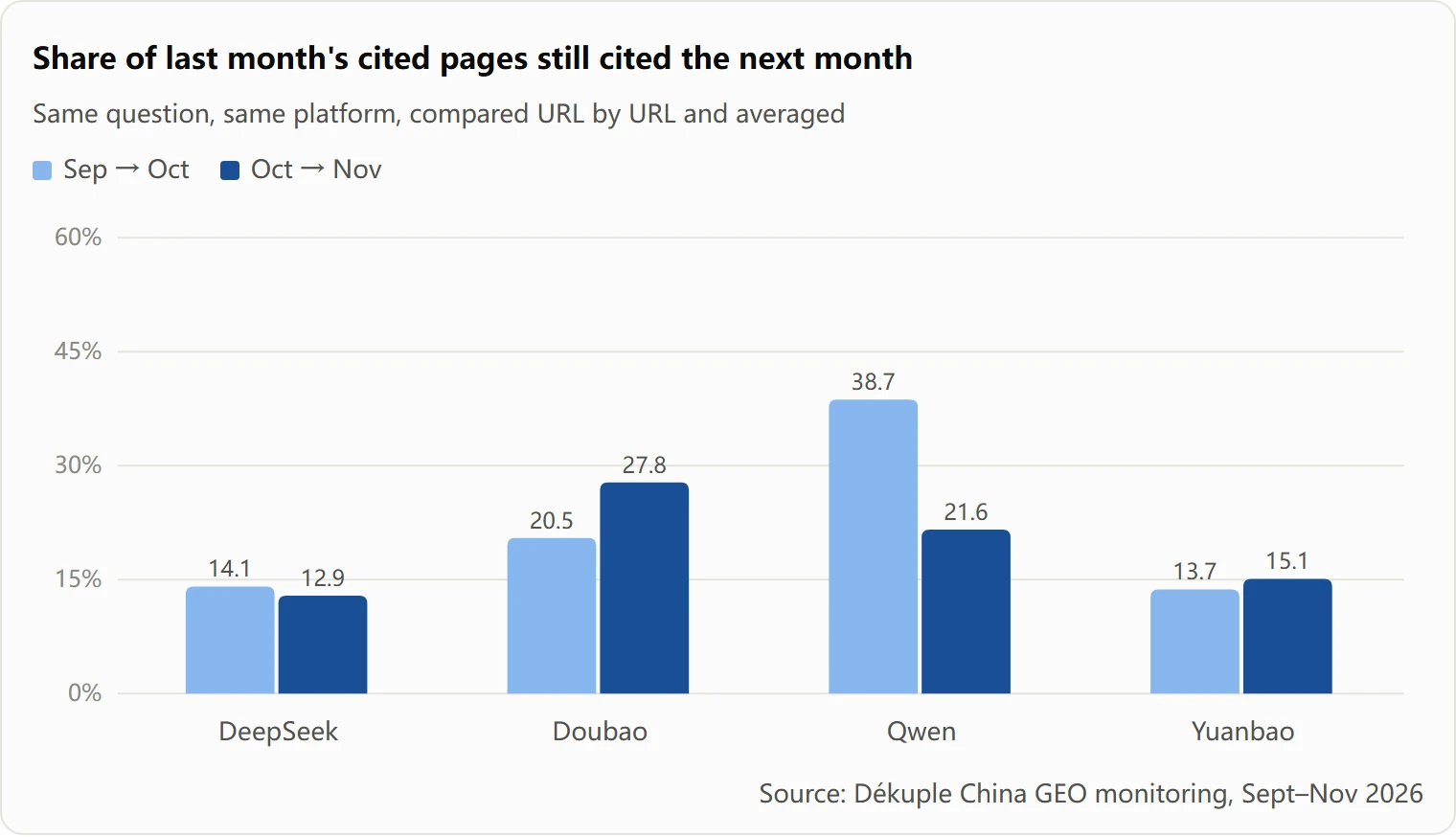
- DeepSeek and Yuanbao keep only about 14% of pages from one month to the next. Doubao keeps a little over 20%, and Qwen is the most stable.
- Even at domain level, the overlap between consecutive months is only 17%–31%.
- Each month, 14%–29% of citations come from domains the platform had never cited before.
- For the same question in the same month, any two platforms share only 5%–10% of their cited domains.
Two things follow. First, a source position is not held once won: content has to be refreshed every month. Second, each platform has its own source pool, and being cited on one does not mean being cited on the others. Another of our studies found the same: DeepSeek and Doubao cite almost entirely different pages.
Finding 2: Qwen doubled its citations per answer
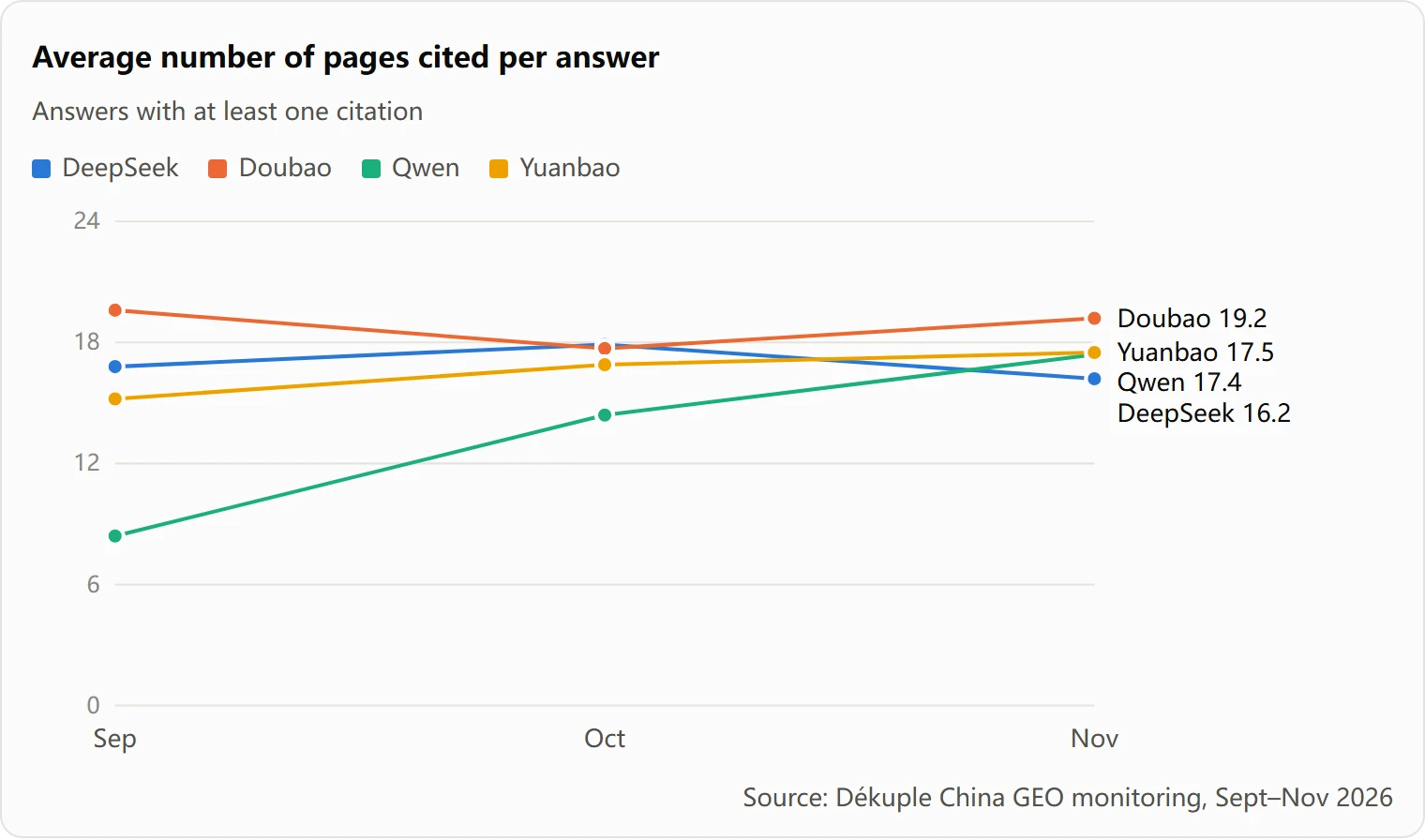
Qwen cited 8.4 pages per answer in September, 14.4 in October and 17.4 in November. Distinct domains per answer rose from 6.4 to 12.4. The collection method was the same in all three months, so this is not a collection effect. The other three platforms stayed between 16 and 20.
In Qwen's mix, industry portals fell from 26% to 19% of citations and company websites rose from 34% to 39%. For brands, more citations mean more chances to get in, but competitors' websites get in too: the client's site was cited on more questions, while its share of all Qwen citations went down.
The platforms have announced nothing. We can only judge from the results: a change this large, in the same direction for two months under the same collection method, is very likely a product or retrieval change. Baidu is one of the few platforms that publishes this kind of data; see how to use Baidu AI traffic analysis.
Finding 3: Yuanbao cut overseas sites and added WeChat articles
On knowledge questions, the share where Yuanbao cited the client's website fell from 20.9% in September to 4.4% in October and 5.5% in November. Almost all of the loss was the client's overseas English-language site. The other three platforms all went up over the same period.
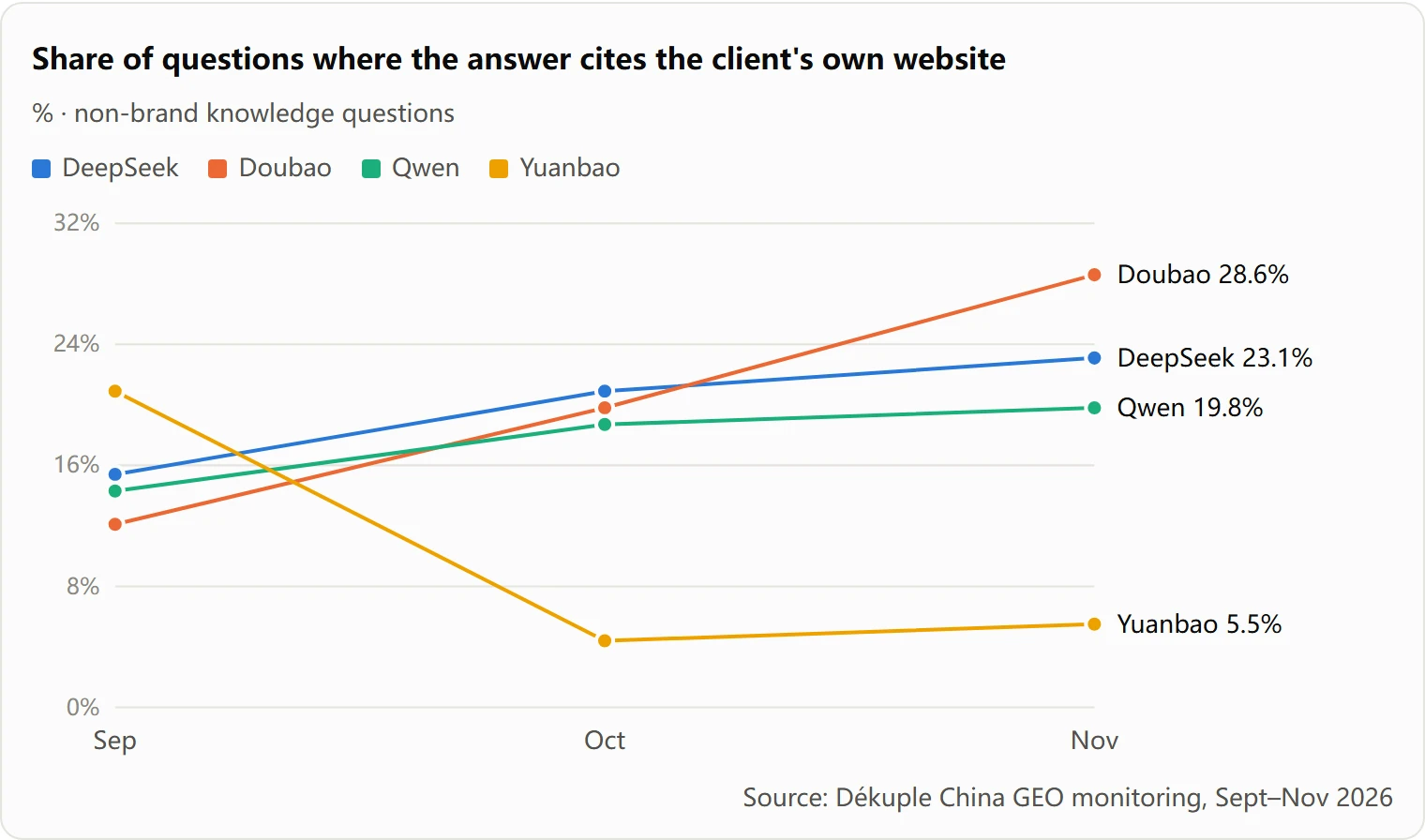
Yuanbao's own source mix moved as well:
- English and overseas content fell from 13.3% to 6.3% of its citations.
- WeChat official account articles rose from 7.3% to 11.6%.
- Government, standards and testing bodies rose from 5.2% to 11.8%.
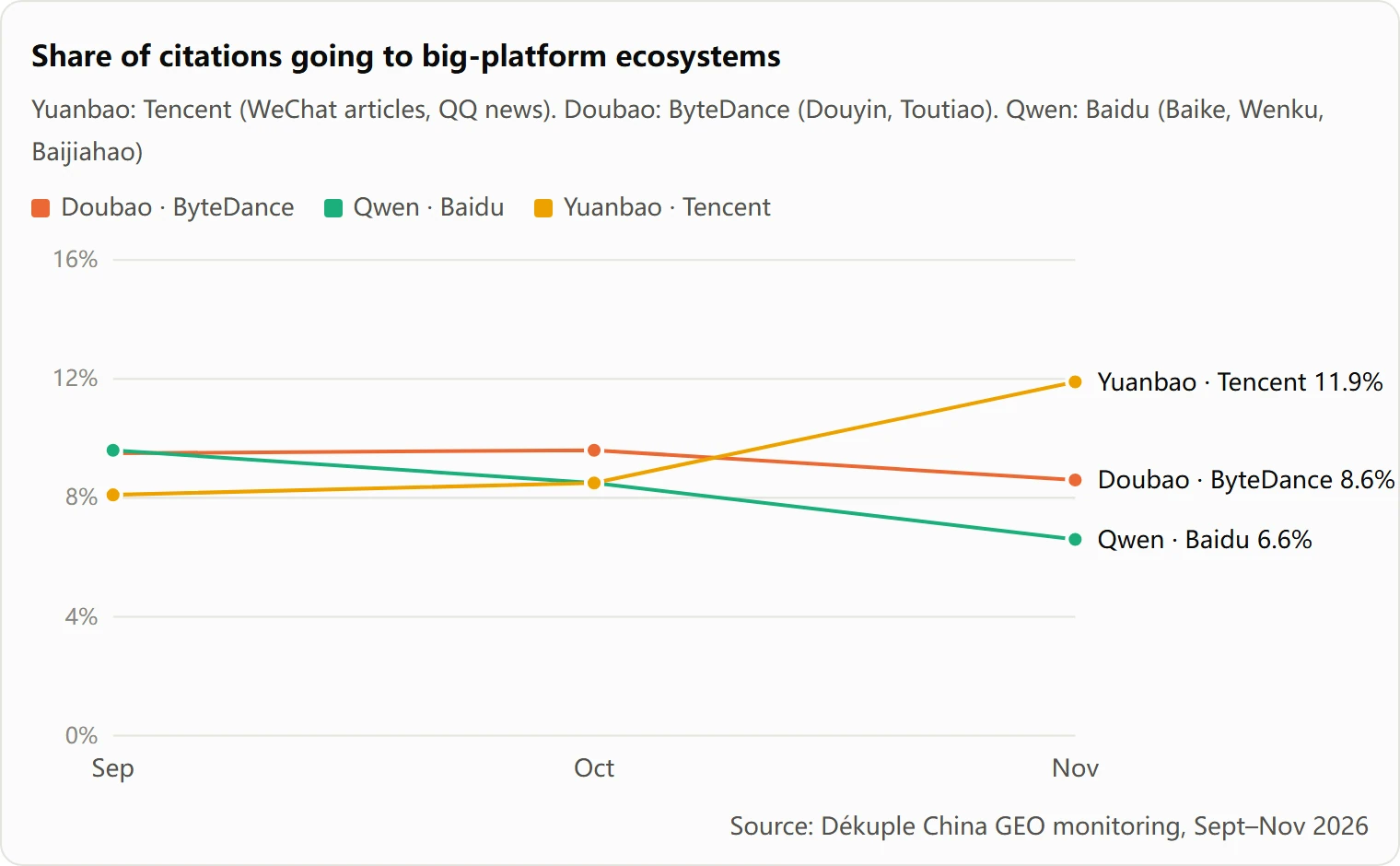
Only Yuanbao cites WeChat official accounts; the other three are close to zero. Doubao's citations of Douyin and Toutiao are steady at about 9%. Qwen belongs to Alibaba but cites almost no Alibaba content. Its largest big-platform sources are Baidu Baike and Baidu Wenku, and that share is falling. For what makes official account content work, see is WeChat official account content worth it for B2B brands.
Yuanbao citing fewer overseas sites is also linked to the search engine it relies on; see where AI citations come from.
Finding 4: for "who do you recommend", half of Doubao's sources are Douyin
The same platform uses very different sources for different kinds of question.
| Sources for recommendation questions (Nov) | DeepSeek | Doubao | Qwen | Yuanbao |
|---|---|---|---|---|
| Social media (mostly Douyin) | 2.6% | 51.4% | 4.6% | 0.8% |
| Company websites | 54.8% | 24.5% | 43.7% | 42.6% |
| Portals and industry sites | 20.1% | 5.6% | 29.9% | 19.5% |
| WeChat official accounts | 0% | 0% | 0% | 10.7% |
When Doubao answers recommendation questions, more than half of its sources are Douyin videos: 54% in October and 51% in November. On knowledge questions Douyin is only about 8%. Even for B2B products, when the user asks which brand is good, Doubao looks at Douyin first. This kind of content is part of social media management, and our AI search analysis of central air conditioning found the same pattern.
DeepSeek stands out for citing patents and papers. In October the share of PDF files in its citations jumped from 9% to 35%, mostly patent documents, then fell back to 17% in November. That looks like a one-off swing, not a lasting change. DeepSeek also replaces its sources fastest of the four.
Finding 5: being cited and being recommended go together
We split the 400-plus recommendation answers from October and November into two groups, by whether they cited the client's website:
| Answer cites the client's website? | Share of all answers | Recommend the brand |
|---|---|---|
| Yes | About 36% | 92% |
| No | About 64% | 23% |
This is a correlation and does not prove cause: an AI may decide to recommend a brand first and then look up its website. But it does show that having website pages in the AI's retrieval results is the most reliable sign that a brand makes the shortlist. The website has to be indexed by search engines first, which is what SEO and SEM search marketing takes care of.
One more number worth noting: on knowledge questions, about 80% of the client-website content AI cited came from the overseas English-language site, and only 13%–22% from the Chinese site. Chinese AI platforms do cite solid English product pages when answering Chinese questions. Yuanbao's change shows the risk: once a platform cites fewer overseas sites, the brand's citation rate drops directly.
Over the three months, the share of recommendation answers that mentioned the brand rose by about 10 percentage points.
The overall mix of source types
Pages change, but the mix of source types is fairly stable. The table shows all four platforms together (knowledge and brand questions):
| Source type | Sept | Oct | Nov |
|---|---|---|---|
| Company websites (incl. competitors) | 45.2% | 45.0% | 42.9% |
| Portals and industry sites | 13.2% | 13.3% | 12.2% |
| Government, standards, patents, institutions | 8.9% | 11.2% | 11.6% |
| Client's own website | 9.2% | 9.5% | 8.6% |
| Document libraries | 5.2% | 4.3% | 4.5% |
| Journals and academic | 4.3% | 3.9% | 4.3% |
| Social media | 3.2% | 3.3% | 3.4% |
| Encyclopedias | 2.7% | 2.6% | 3.2% |
| WeChat official accounts | 1.9% | 2.1% | 2.8% |
| Q&A communities | 1.4% | 1.0% | 0.8% |
| Other | 4.9% | 3.8% | 5.6% |
Company websites stay above 40% and are the main source for B2B questions. Government and standards sources and WeChat official accounts are rising; Q&A communities such as Zhihu are falling. For how industry portals become AI sources, see auto media platforms: from selling traffic to selling sources.
What this means for brands
- Run GEO as a monthly operation. Most sources are replaced every month, so one round of publishing does not hold a position. Our off-site articles got only a fifth as many citations in their second month as in their first.
- Build solid content on the Chinese website first. Company websites are the largest source, and being cited goes together with being recommended. A brand with only an overseas English site loses out on platforms like Yuanbao.
- Prepare content per platform. Yuanbao reads WeChat official accounts, Doubao reads Douyin for recommendation questions, DeepSeek reads patents and papers, and Qwen reads company websites and industry portals. The four platforms share less than 10% of their sources, so one set of content cannot cover them all.
- Cite standards in technical content. Government and standards sources are gaining share. Articles that explain national or industry standards and give the exact standard number are more likely to be cited.
- Retest the same questions every month. Platforms do not announce changes. Only steady monitoring will catch them.
To see how your brand does on these four platforms, see our generative engine optimization (GEO) service, or read five calls on GEO for brands and our practical GEO guide.
Notes on the data
- The data comes from 100-plus questions for one B2B brand. Consumer categories will have a different source mix, with more social media for example.
- Our reading of platform changes is inferred from results. The platforms made no announcements.
- Three-month source comparisons use only the knowledge and brand questions, because September citation data for recommendation questions is incomplete.
- Doubao data was exported in a different way in November, and the number of questions with citations rose at the same time, so we draw no conclusions on Doubao's volume changes.
- Source types are assigned by domain. Doubao data carries no source names, so more of its domains could not be classified.
Further reading: what foreign companies should know about Douyin ads.
Key Data & Sources
| Data | Value | Source |
|---|---|---|
| Scope | 100+ Chinese-language B2B questions (knowledge, recommendation, brand) on DeepSeek, Doubao, Qwen and Yuanbao, Sept–Nov 2026, tens of thousands of citations | Dékuple China GEO monitoring, Sept–Nov 2026 |
| Monthly page retention | DeepSeek 14.1% / 12.9%, Doubao 20.5% / 27.8%, Qwen 38.7% / 21.6%, Yuanbao 13.7% / 15.1% (Sept→Oct / Oct→Nov) | Dékuple China GEO monitoring, Sept–Nov 2026 |
| Qwen citations per answer | 8.4 in September, 14.4 in October, 17.4 in November | Dékuple China GEO monitoring, Sept–Nov 2026 |
| Yuanbao citing the client's website | 20.9% in September, 4.4% in October, 5.5% in November (knowledge questions); WeChat articles 7.3% → 11.6% | Dékuple China GEO monitoring, Sept–Nov 2026 |
| Douyin share in Doubao recommendation answers | 54.2% in October, 51.4% in November | Dékuple China GEO monitoring, Oct–Nov 2026 |
| Website citation and brand recommendation | 400-plus recommendation answers: 92% of those citing the website recommended the brand, against 23% of those not citing it | Dékuple China GEO monitoring, Oct–Nov 2026 |
FAQ
How often do the sources AI cites change?
In our monitoring, for the same question on the same platform, only 13%–39% of the pages cited one month were still cited the next. DeepSeek and Yuanbao change fastest, keeping about 14% a month; Qwen is the most stable.
Do different AI platforms cite the same sources?
No. For the same question in the same month, any two platforms share only 5%–10% of their cited domains. Yuanbao cites WeChat official accounts, Doubao cites Douyin for more than half of its recommendation sources, and DeepSeek cites many patents and papers.
How can you tell whether an AI platform has changed its algorithm?
Platforms rarely announce it. The practical way is to ask the same questions the same way every month and watch citations per answer, the mix of source types and how often your own website is cited. A large change in the same direction for two months is very likely an adjustment.
If AI cites my website, will it recommend my brand?
The two go together. Of 400-plus recommendation answers, 92% of those that cited the brand's website recommended the brand, against 23% of those that did not. This is a correlation and does not prove cause.