

How We Use BrandLens to Diagnose a Brand's AI Visibility: From Scoring Method to Strategy

BrandLens scores each brand in every AI answer on five factors: position, recommendation, share of the answer, mentions and sentiment. It then adds up coverage and stability across questions, so a brand knows whether to defend, expand, strengthen or rebuild, and retests monthly.
Before GEO, find out what AI says about you today
When brands start GEO (generative engine optimization), the first question is usually "where do we rank in AI?" Asking AI a few times on a phone and taking screenshots cannot answer it: AI answers vary from one run to the next, vary even more between questions, and screenshots cannot be compared side by side with competitors.
That is why we built BrandLens. It reads real answers from Doubao, DeepSeek, Qwen and Yuanbao, gives every brand in the answer a visibility score from 0 to 100, and combines many questions into one brand ranking. Every GEO project we run starts with a BrandLens diagnosis.
Take premium skincare as an example. We asked Doubao 13 questions, such as "Which anti-ageing serum is best after 40?", "Premium anti-ageing serums for sensitive skin", "Which cream for recovery after aesthetic treatments?" and "Luxury skincare gift sets for a girlfriend", then put the 13 answers through BrandLens together.
Step one: the right questions matter more than the right platform
A diagnosis is only as good as its questions. We follow three rules:
- Start from real customer needs: ask about "anti-ageing serums for sensitive skin", not "is brand X any good". Customers rarely type brand names into AI; they describe their problem.
- Cover different situations: age, skin type, post-treatment care, gifting, night repair. Each one is a chance to be recommended or ignored.
- Use the data you already have: keywords that convert in SEM and the questions customer service and sales hear most are the best sources.
BrandLens can be used in three ways: analyse a single shared answer link for a quick look at one question; paste many shared links at once for a batch analysis of a fixed question list; or use Brand Radar, which takes a brand name and website, generates questions automatically and checks whether the brand is recommended across several AI platforms.
Step two: score each brand in each answer on five factors
For each AI answer, BrandLens works in five steps: it identifies every brand mentioned, counts how often each one appears, records where it first appears, measures how much of the answer is about it, and judges the sentiment and strength of recommendation. The five factors are weighted into one score:
| Factor | Weight | What it measures |
|---|---|---|
| First position | 25% | Where the brand first appears; earlier scores higher |
| Recommendation | 25% | Five levels, from strongly recommended to use with caution |
| Share of answer | 20% | How much of the answer is about the brand |
| Mentions | 15% | Compared with the most-mentioned brand in the same answer |
| Sentiment | 15% | Five levels, from very positive to very negative |
Position and recommendation carry the most weight because what shapes a decision is which brand AI names first and which it clearly recommends. A passing mention will not score high. We treat 85 and above as high visibility, 70 to 84 as fairly high, 55 to 69 as medium and 40 to 54 as fairly low.
AI also gets brand recognition wrong, for example treating an ingredient or a sales channel as a brand, or counting a brand's Chinese and English names as two brands. BrandLens lets us remove non-brands and merge aliases by hand, then recalculates so the ranking is clean.
Step three: combine questions to see coverage, quality and stability
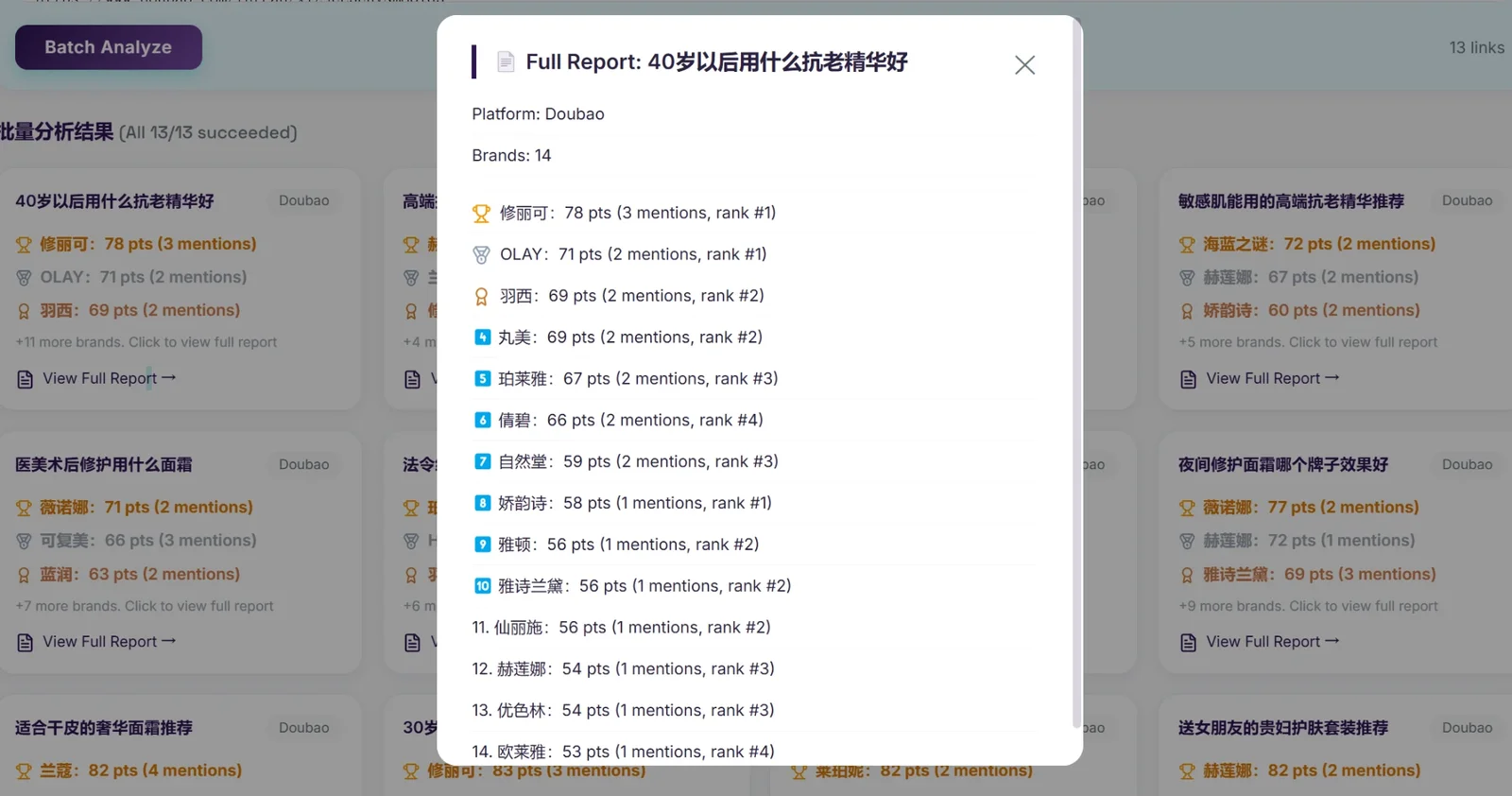
A single question is full of chance. For "Which anti-ageing serum is best after 40?", Doubao named 14 brands. SkinCeuticals came first with 78 points, followed by OLAY, Yue Sai and Marubi, all at 69 or more. Change the question and the list can look completely different. What really helps is the view across questions:
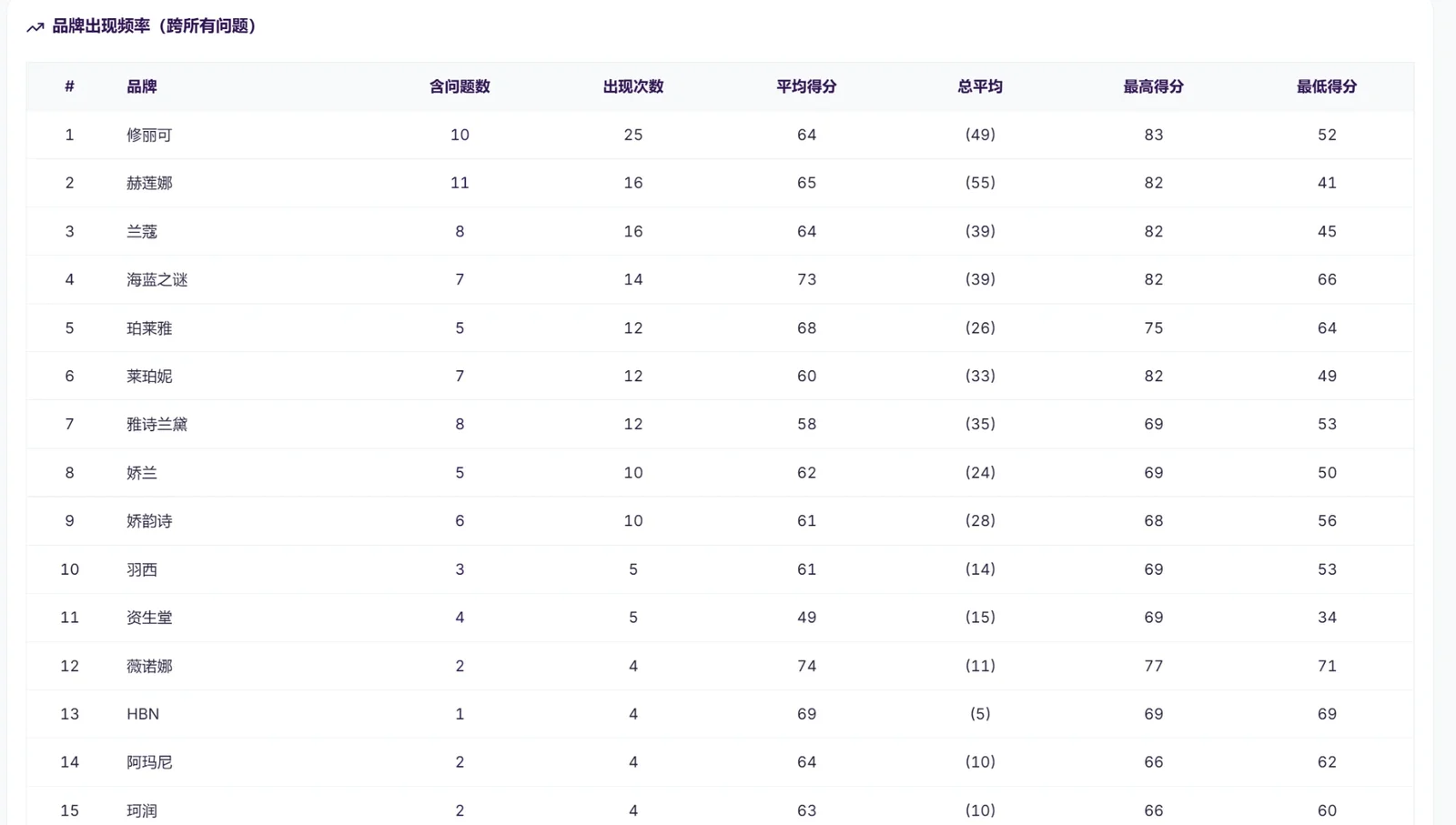
| Brand | Questions (of 13) | Appearances | Average score | Overall average | High / low |
|---|---|---|---|---|---|
| SkinCeuticals | 10 | 25 | 64 | 49 | 83 / 52 |
| Helena Rubinstein | 11 | 16 | 65 | 55 | 82 / 41 |
| Lancôme | 8 | 16 | 64 | 39 | 82 / 45 |
| La Mer | 7 | 14 | 73 | 39 | 82 / 66 |
| Proya | 5 | 12 | 68 | 26 | 75 / 64 |
| La Prairie | 7 | 12 | 60 | 33 | 82 / 49 |
| Estée Lauder | 8 | 12 | 58 | 35 | 69 / 53 |
| Shiseido | 4 | 5 | 49 | 15 | 69 / 34 |
| Winona | 2 | 4 | 74 | 11 | 77 / 71 |
What each column tells you:
- Questions is coverage: in how many of the 13 answers the brand appears.
- Average score is quality: how well the brand scores when it does appear.
- Overall average counts the questions where the brand is missing as zero. It combines coverage and quality and comes closest to the brand's "AI share" of the category.
- The gap between high and low is stability: the wider it is, the more differently the brand is treated from one situation to another.
What this data tells us
Premium skincare has no default answer on Doubao yet. The highest overall average, Helena Rubinstein's, is only 55. No brand both covers most questions and scores above 70 consistently. For brands, the positions are not filled yet, so investing now pays back more than after the category settles.
La Mer's problem is coverage, not quality. It appears in only 7 questions, but averages 73 with a low of 66, the most stable brand in the table. When AI mentions it, it speaks highly of it; what it lacks is being remembered in more situations.
SkinCeuticals is mentioned most, but not always first. It appears 25 times across 10 questions, two or three times per answer, yet averages 64. The next step is to open the single-question reports and see where it ranks lower and what reasons AI gives.
Helena Rubinstein has the widest coverage but swings the most. It appears in 11 questions, with a high of 82 and a low of 41. In some situations AI lists it without giving a reason to choose it.
Brands built around a need can punch above their weight. Winona appears in only 2 questions, but ranks first in both: recovery after aesthetic treatments and night repair cream. Proya appears in 5 questions with an average of 68. When the need is specific, AI cares more about fit than price tier.
AI decides who your competitors are. For "Which anti-ageing serum is best after 40?", OLAY, Yue Sai and Marubi sit alongside premium brands. Competitor analysis cannot stop at brands in the same price range.
Step four: turn the diagnosis into strategy: defend, expand, strengthen, rebuild
We place each brand on two dimensions, coverage and average score, which gives four situations with different actions:
| Situation | Strategy | What to do |
|---|---|---|
| Wide coverage, high score | Defend | Update brand facts and product information every quarter and watch new competitors so you are not replaced |
| Narrow coverage, high score (e.g. La Mer, Winona) | Expand | Find the questions where you are missing and add content for them: ingredient explainers, who it suits, how to use it, comparison Q&A |
| Wide coverage, average score (e.g. SkinCeuticals, Estée Lauder) | Strengthen | Read the reasons and sentiment AI gives, then add convincing evidence such as clinical data, authoritative reviews and real user feedback |
| Narrow coverage, low score (e.g. Shiseido) | Rebuild | First check whether what AI says is accurate, then fill in the basics on the website, encyclopedias and authoritative media |
If the client's brand does not appear at all, BrandLens marks it as "client brand, no exposure". The first step then is not to rush out content but to see which competitors hold these questions and which websites AI cites. Looking at sources platform by platform matters, because different AI platforms cite very different websites.
Note that defend, expand, strengthen and rebuild here illustrate the method with one public test; they are not a judgement of these brands. In real projects we choose questions and set priorities around the brand's own products, audiences and channels.
Step five: retest monthly and connect visibility to business
AI answers change: model updates, newly indexed content and competitor activity all shift the rankings. One diagnosis is only a starting point. Here is how we work:
- Keep a fixed question list and retest monthly: run the same questions on the same platforms and track the overall average, question coverage and lowest score. Batch results can be exported to Excel for comparison.
- Test important questions more than once: AI answers are partly random, so look at trends rather than single results.
- Read it alongside business data: as visibility rises, watch the share of leads citing AI, branded search volume and direct website traffic. We cover these metrics in Five calls on GEO for brands.
Want to know where your brand stands in Doubao, DeepSeek, Qwen and Yuanbao? Read about our GEO service, or contact us and we can start with a BrandLens diagnosis.
BrandLens shows one point in time. For how sources and shortlists move from month to month, see our data report: AI sources change every month.
To track results month by month after the diagnosis, see how to measure GEO results: 4 metrics and a monthly dashboard.
Further reading: how to choose an AI visibility monitoring tool.
Key Data & Sources
| Data | Value | Source |
|---|---|---|
| Premium skincare questions tested on Doubao | 13 questions; 14 brands named in the question about anti-ageing serums after 40 | Dékuple China BrandLens test, November 2026 |
| Brand frequency across 13 questions | Helena Rubinstein in 11 questions, overall average 55; La Mer average 73, low 66; SkinCeuticals 25 appearances | Dékuple China BrandLens test, November 2026 |
| BrandLens visibility score weights | First position 25%, recommendation 25%, share of answer 20%, mentions 15%, sentiment 15% | Dékuple China BrandLens methodology |
FAQ
Which AI platforms does BrandLens support?
Doubao, DeepSeek, Qwen and Yuanbao. It can analyse a single shared answer link, a batch of links at once, or use Brand Radar to generate questions automatically and check several platforms.
How is the BrandLens visibility score calculated?
Each brand in each answer is scored on five weighted factors: first position 25%, recommendation 25%, share of answer 20%, mentions 15% and sentiment 15%, out of 100. Across questions we then look at coverage, average score, overall average and the high and low scores.
What is the difference between average score and overall average?
Average score only counts the questions where the brand appears, so it shows quality when present. Overall average counts missing questions as zero, so it reflects both coverage and quality and comes closer to the brand's AI share of the category.
How many questions does a diagnosis need?
We suggest starting with 10 to 30 questions close to real customer needs, covering different situations and audiences. With too few questions, the result depends too much on the randomness of single answers.