

Chinese AI models compared (November 2026): how Kimi, Qwen and DeepSeek stack up, and what they can do for everyday marketers

Kimi K3.1 Pro and Qwen4 Max lead China's models but trail the global leader by about 18 points; DeepSeek and Xiaomi MiMo win on cost. Marketers should match models to tasks and make sure the brand appears in their answers.
The short version: where Chinese models stand
Artificial Analysis is the most widely cited independent benchmark for AI models. Its Intelligence Index v5.0.2 combines nine evaluations covering agentic knowledge work, SaaS workflow automation, coding, professional document reasoning and knowledge accuracy, which is closer to "getting real work done" than simple Q&A. We read the latest data on 25 November 2026. Three takeaways:
- China's top tier: Moonshot AI's Kimi K3.1 Pro scores 47 and Alibaba's Qwen4 Max 43, well ahead of other Chinese models;
- Still behind the global frontier: the leader, Claude Fable 5.2, scores 65, and GPT-6.2 Astra and Gemini 4 Neon score 62. China's best is about 18 points behind, roughly level with the West's previous tier of flagships;
- A big price advantage: DeepSeek V4.1 Flash costs about $0.60 per task and Xiaomi's MiMo-V2.6-Pro $0.26, against $26.54 for the global leader.
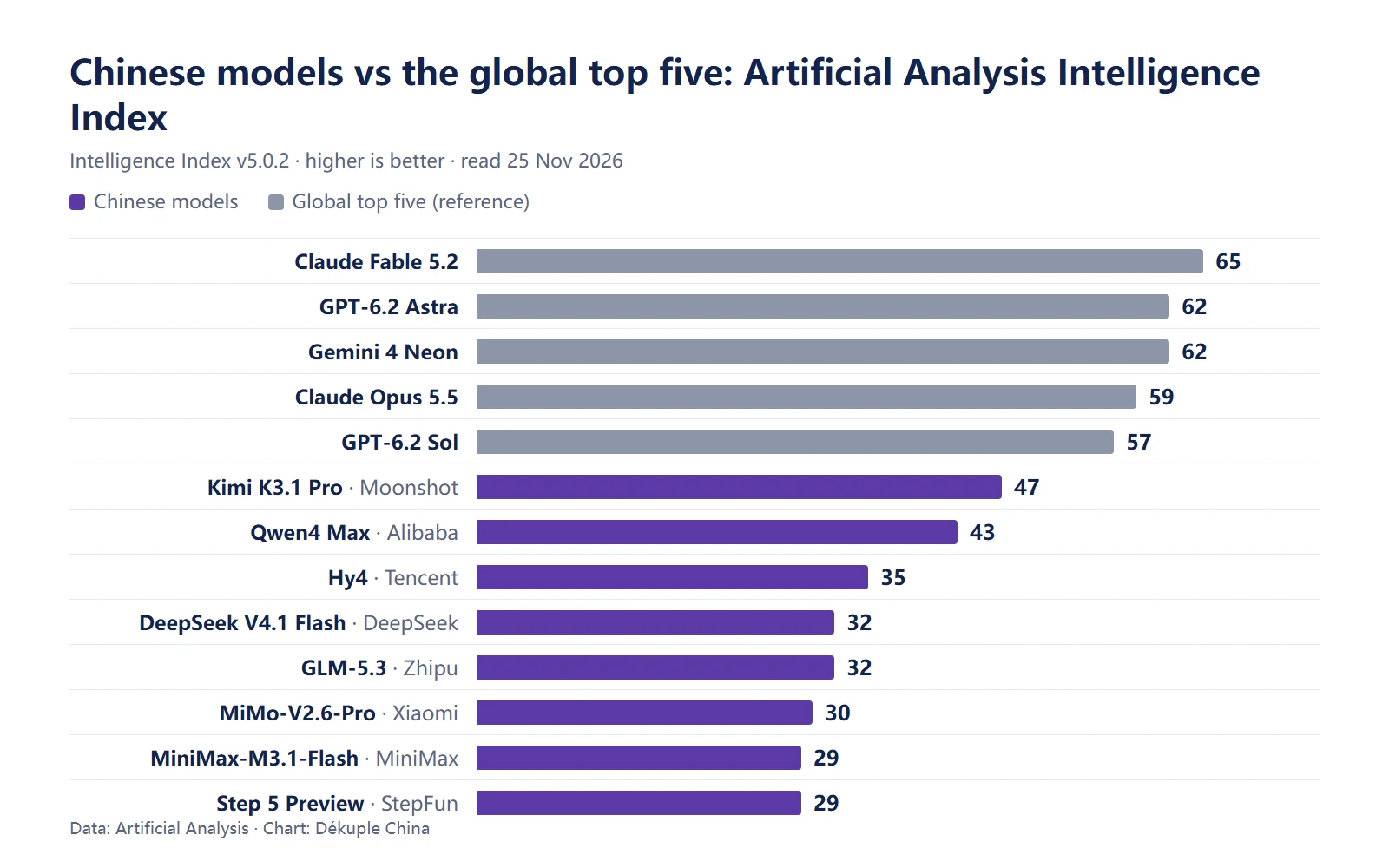
The main Chinese models at a glance
The table lists the main Chinese models with a full score on the Artificial Analysis leaderboard. Cost and time per task are the average spend and wait to run one evaluation task: roughly, what it costs and how long it takes to hand the model one complex piece of work.
| Model | Developer | Intelligence Index | Cost per task | Time per task |
|---|---|---|---|---|
| Kimi K3.1 Pro | Moonshot AI | 47 | $3.68 | 34.0 min |
| Qwen4 Max | Alibaba | 43 | $3.27 | 18.7 min |
| Hy4 | Tencent | 35 | $1.03 | 13.4 min |
| DeepSeek V4.1 Flash | DeepSeek | 32 | $0.60 | 13.6 min |
| GLM-5.3 | Zhipu (Z.ai) | 32 | $5.01 | 28.1 min |
| MiMo-V2.6-Pro | Xiaomi | 30 | $0.26 | 48.8 min |
| MiniMax-M3.1-Flash | MiniMax | 29 | $0.49 | 17.6 min |
| Step 5 Preview | StepFun | 29 | $2.35 | 24.2 min |
For reference: the global leader, Claude Fable 5.2, scores 65 at $26.54 per task; GPT-6.2 Astra and Gemini 4 Neon both score 62.
Note that ByteDance's Doubao is not in this index (only its coding model, Doubao Seed Code, is listed, without a score), and Baidu's ERNIE has no full score either. Missing from the index does not mean weak, only that there is no comparable data. China's own SuperCLUE benchmark also ranks Kimi-K3.1-Pro first among Chinese models in November, consistent with Artificial Analysis.
Value for money: the strongest is not always the best fit
Plot intelligence against cost per task and the split is clear. Kimi and Qwen hold China's high-capability corner, while DeepSeek, Tencent Hy4, MiniMax and Xiaomi's MiMo sit in the cheap-and-good-enough zone. Much day-to-day marketing work does not need the top-scoring model.
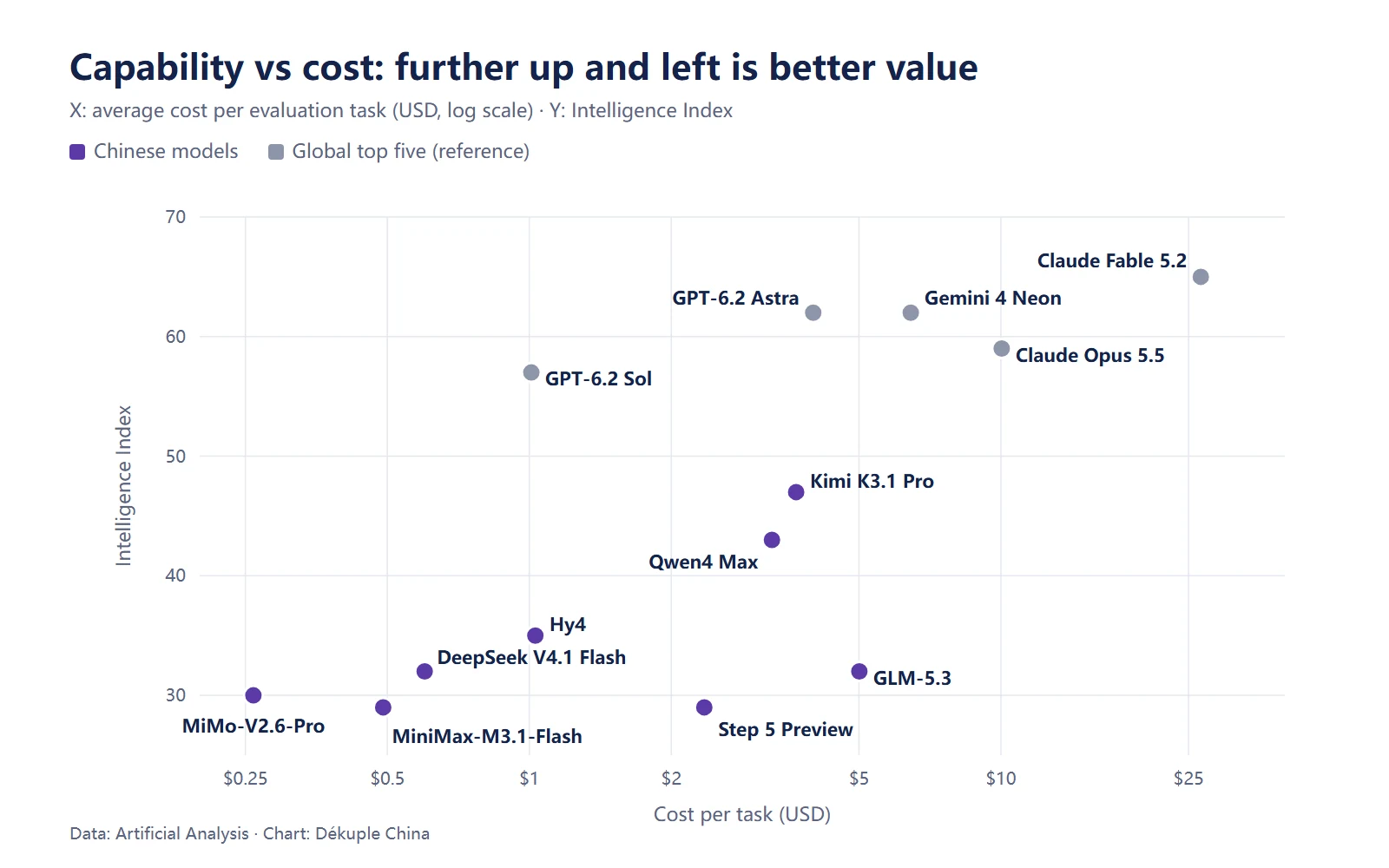
One caveat: the index tests reasoning, coding and agentic tasks. It does not directly measure Chinese copywriting, brand voice or social media instinct. For Xiaohongshu notes or WeChat headlines, the differences between models are best found by testing on your own samples.
From a marketer's point of view: what these models can help with
Based on how we use them in client projects, these are the five areas where everyday marketing and communications staff get the most out of them:
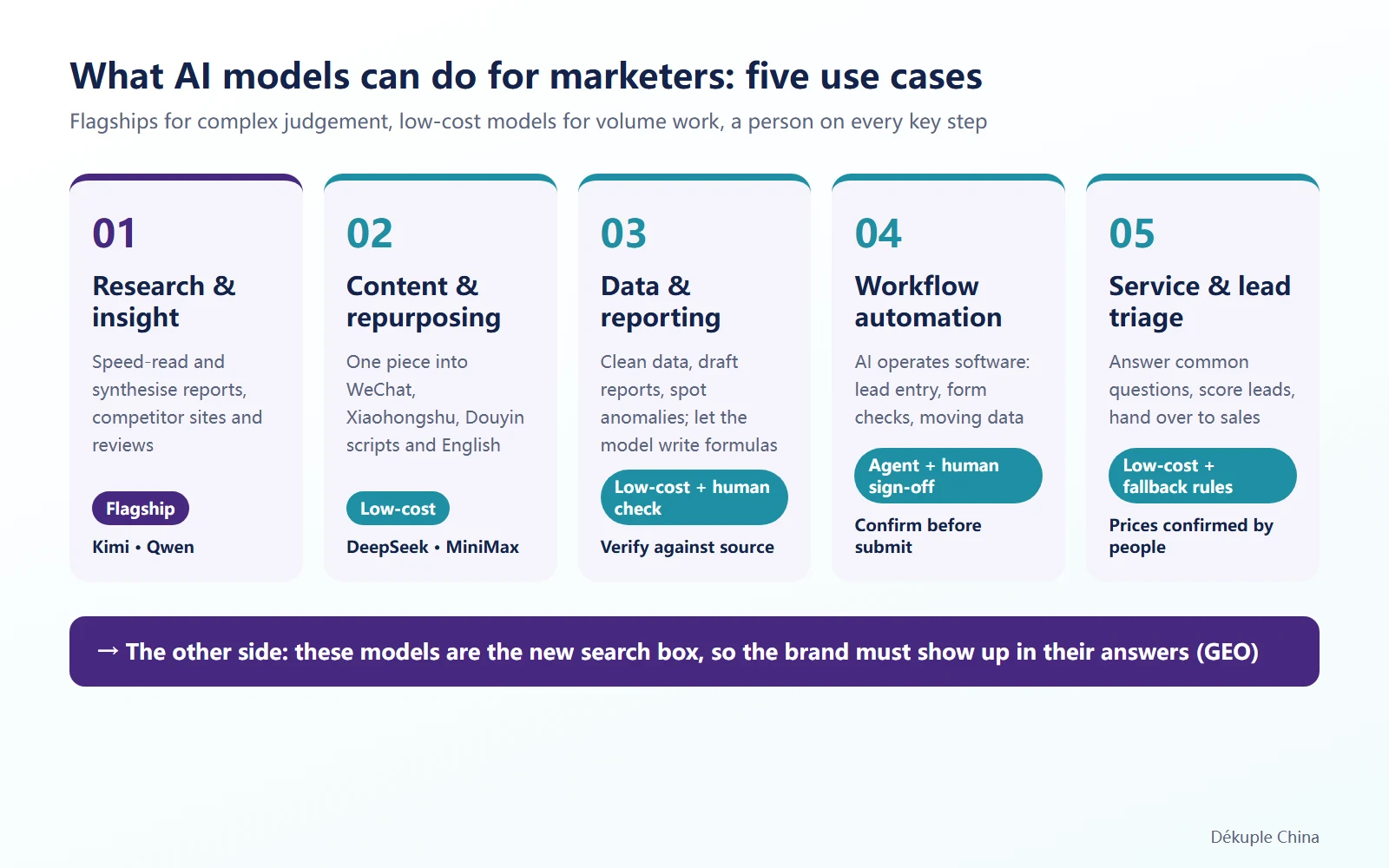
- Research and insight. Reading industry reports, competitor websites, tender documents and reviews, then turning them into conclusions. Leading Chinese models handle around a million tokens of context, enough for dozens of files at once. Flagships like Kimi or Qwen are steadier for complex synthesis. To turn insight into audiences, see building B2B personas in 5 steps.
- Content production and repurposing. Turning one long article into a WeChat post, Xiaohongshu notes, Douyin scripts and an English version. Write a brand voice guide with examples first, let the model rewrite in bulk, and keep a human final check. Low-cost models like DeepSeek or MiniMax are enough for this kind of volume work.
- Data and reporting. Cleaning ad and website data, drafting weekly and monthly reports, spotting anomalies. Ask the model to write formulas or scripts rather than do the arithmetic itself, and check results against the source sheet.
- Workflow automation. AI can now operate software and move data between systems, as in WorkBuddy's computer use. Lead entry and form checks benefit first, and lead nurturing can then run through SCRM and marketing automation.
- Customer service and lead triage. Answering common questions and scoring leads before passing them to sales. Set fallback replies, and have a person confirm anything involving prices or commitments.
The other side: these models are the new search box
Kimi, Qwen, DeepSeek, Tencent Yuanbao and Doubao all run on these models. More and more buyers simply ask an AI which brand is best, so marketers are not only AI users: the brand also needs to appear in AI answers. That is GEO (generative engine optimization).
Two points tie directly to this leaderboard. First, different models cite very different web pages: our own test found that DeepSeek and Doubao barely cite the same pages. Second, user reach and leaderboard rank are not the same thing: Doubao is missing from this index yet is one of China's most-used AI assistants. GEO should follow the assistants your customers actually use, not just the highest scores. For practical steps, see how to get your brand into DeepSeek's answers.
Five directions to start with
- Match models to tasks instead of chasing the strongest. Flagships for complex judgement, low-cost models for volume work; using two or three models in one team is normal;
- Build a brand knowledge base first. Product material, brand voice, banned words and good examples in one document shared by every model make output far more consistent;
- Pilot small and measure. Pick one frequent task, try it for two weeks, record time saved and rework, then decide whether to roll it out;
- Keep data and compliance boundaries. For customer personal data, unpublished prices and contracts, agree with legal and IT which model may handle what;
- Watch how AI recommends you. Check regularly how the brand appears in each assistant, with a tool such as Brand Pulse; for how to measure results, see 4 metrics for GEO. To do it systematically, see our GEO service.
Key Data & Sources
| Data | Value | Source |
|---|---|---|
| Artificial Analysis LLM leaderboard (read 25 Nov 2026) | Intelligence Index v5.0.2, cost and time per task | Artificial Analysis |
| Artificial Analysis model comparison | Intelligence, performance and price | Artificial Analysis |
| SuperCLUE Chinese LLM benchmark | November 2026 general ranking | SuperCLUE |
FAQ
Which Chinese AI model is strongest in November 2026?
On the Artificial Analysis Intelligence Index v5.0.2, Moonshot AI's Kimi K3.1 Pro leads Chinese models with 47, followed by Alibaba's Qwen4 Max with 43. China's SuperCLUE November ranking also puts Kimi-K3.1-Pro first among Chinese models.
How far behind the global leaders are Chinese models?
On the Artificial Analysis Intelligence Index, the leader Claude Fable 5.2 scores 65 and China's best, Kimi K3.1 Pro, scores 47, a gap of about 18 points. Chinese models are far cheaper: about $0.60 per task for DeepSeek V4.1 Flash against $26.54 for Claude Fable 5.2.
Which model should marketers use day to day?
Choose by task: flagships such as Kimi or Qwen for research synthesis and strategic judgement, low-cost models such as DeepSeek or MiniMax for rewriting and bulk content. For Chinese copywriting, test on your own samples.
Why is Doubao missing from the Artificial Analysis index?
This edition of the index does not include Doubao's general model; only the coding model Doubao Seed Code is listed, without a score. That means no comparable data, not weak capability. Doubao remains one of China's most-used AI assistants and matters for GEO.