

WeChat in 2027: how Official Accounts, Channels, WeCom and Mini Programs divide the work, and what the Xiaowei AI agent changes

In 2027 the four WeChat channels keep their jobs. What changes is the entry point: Xiaowei, WeChat's native AI agent, starts searching content, calling Mini Programs and getting things done for users. Brands need Mini Programs AI can call, articles AI can cite, and WeCom data that AI and sales teams can use.
The division of work: four roles in WeChat
Weixin and WeChat reached 1.449 billion combined monthly active accounts in Q3 2026 (Xinhua, in Chinese). For brands, this ecosystem has four main channels, each with its own job:
| Channel | Main job | Typical metrics |
|---|---|---|
| Official Account | In-depth content, brand trust, long-tail search | Reads, shares, WeChat Search exposure |
| Channels | Reach, livestreams, short-video discovery | Views, live viewers, product clicks |
| WeCom | One-to-one contact, groups, customer and lead management (SCRM) | Contacts, engagement, lead conversion |
| Mini Programs | Services and transactions: booking, lookups, orders, membership | Visits, time spent, orders |
For years the playbook has been public reach, then private traffic, then conversion: attract followers with the Official Account and Channels, bring them into WeCom with parametric QR codes, then nurture them with tags and content (see our WeChat SCRM guide). That playbook still holds in 2027, but where it starts is changing.
What happened in 2026: AI arrived in WeChat
1. Mini Programs can now be called by WeChat AI. On 8 June 2026 the WeChat Open Platform published guidelines for developers joining the WeChat AI ecosystem. A Mini Program can use an automatic mode, where the platform reads the source code and adapts it, or a development mode, where the developer builds the integration and passes a review. Only Mini Programs that opt in can be recommended and called by WeChat AI; the switch is on the "AI capabilities" page of the Mini Program admin (Sina Finance, in Chinese).
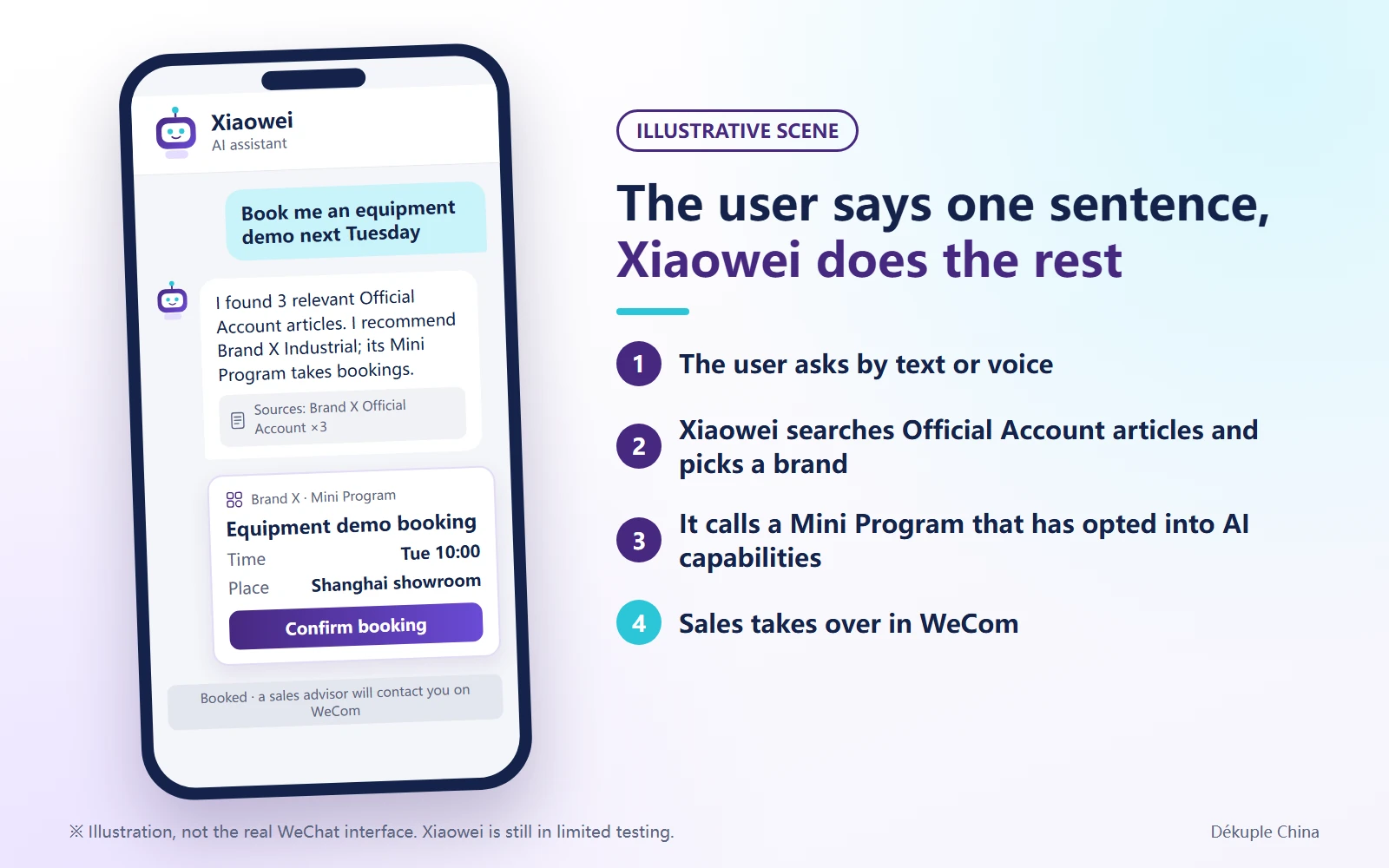
2. Xiaowei, WeChat's native agent, entered testing. From June 2026 Tencent has been testing Xiaowei, a native AI assistant, with a small group of Weixin users. People can talk to it by text or voice; it can message friends and open Mini Programs to order food, book a ride or make a hospital appointment (CNBC). With its Q3 2026 results, Tencent said the Xiaowei test was still widening (Xinhua). As we write, Xiaowei is not open to all users, and its final form is for Tencent to announce.
3. WeCom connected to an office agent. On 14 October 2026 WeCom and WorkBuddy, Tencent's AI office agent, released new versions that share accounts, so WorkBuddy can use the work context inside WeCom (Caixin, in Chinese). We covered other WorkBuddy features in WorkBuddy and the WeChat Pay AI card and WorkBuddy computer use.
4. Official Account content has been in AI search since 2025. In February 2025 WeChat Search began testing an AI search mode, and Tencent said it draws on public information such as Official Account articles (The Paper, in Chinese). So an Official Account article is not only read by followers; it is also a source AI uses to answer questions.
Looking ahead to 2027: how each role shifts
What follows is our view, not Tencent's roadmap.
Mini Programs: from opened by users to called by AI. When a user tells Xiaowei "book an equipment demo for next Tuesday" or "find a distributor for this product", Xiaowei looks for a Mini Program that can do it. A Mini Program that hasn't opted into AI capabilities is invisible to it. By 2027, being callable by AI will be as basic for a Mini Program as being findable in search.
Official Accounts: from push reading to AI source. Falling open rates are old news, but the value of articles is moving: WeChat Search, Yuanbao and Xiaowei retrieve, summarise and cite them. Writing has to adapt: conclusion first, clear questions and answers, sourced data. It is the same standard we apply in GEO, and most of the widely shared articles in our WeChat 10w+ marketing review already work this way.
Channels: still the stage for reach and livestreams, but add text. Channels remains a major source of public reach inside WeChat. AI still reads video poorly, so titles, descriptions, subtitles and a companion article decide whether a video can be understood and cited by AI.
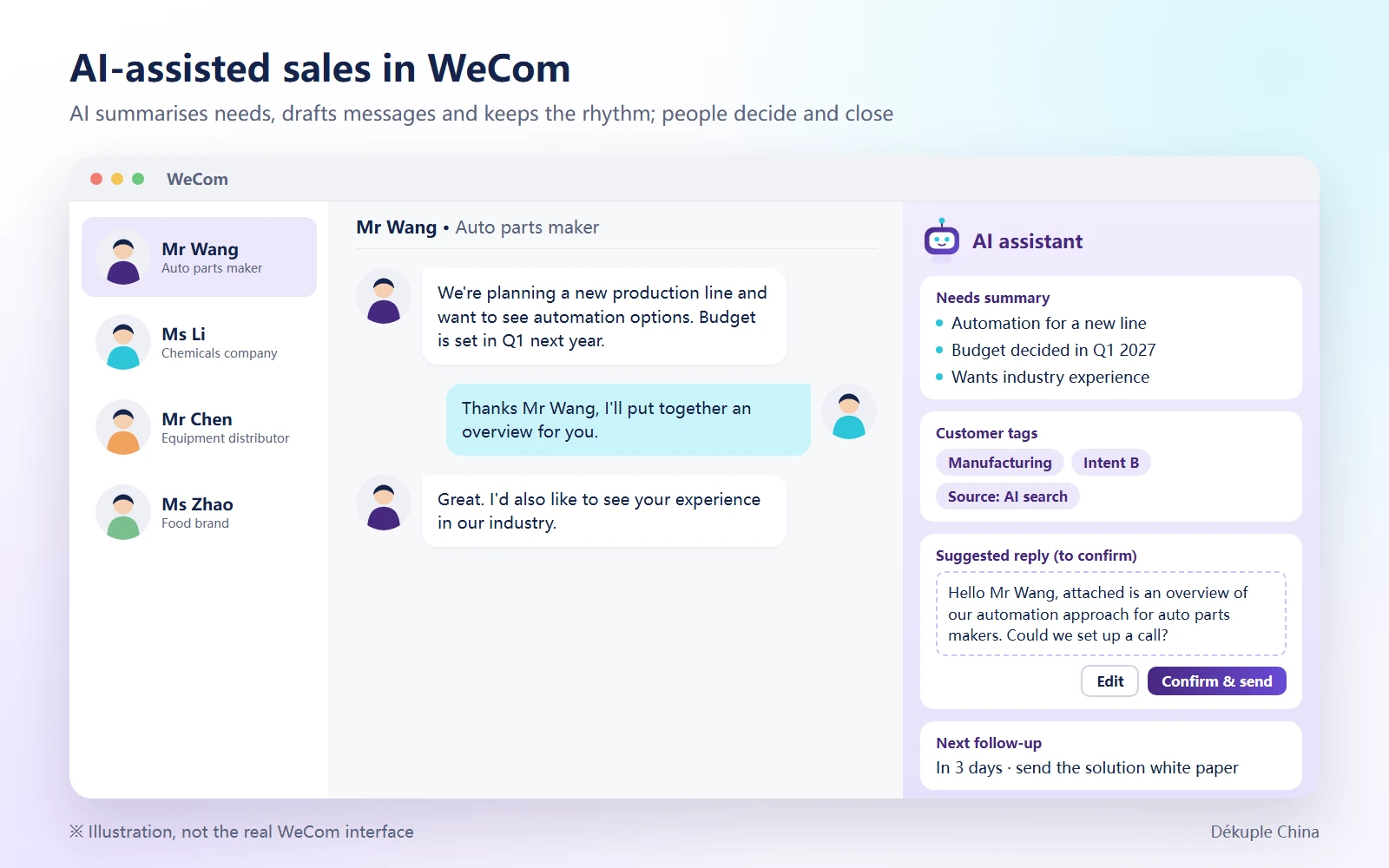
WeCom: AI joins one-to-one service. This is the biggest change for B2B brands. Customer tags, chat history and lead status in WeCom become the context AI uses to understand customers: it can summarise needs for sales, draft follow-ups and prompt the nurture rhythm, while people make the judgement calls and close the deal. That only works with clean data and consistent tags, which is why we keep advising B2B companies to get SCRM right first (see B2B lead management in China).
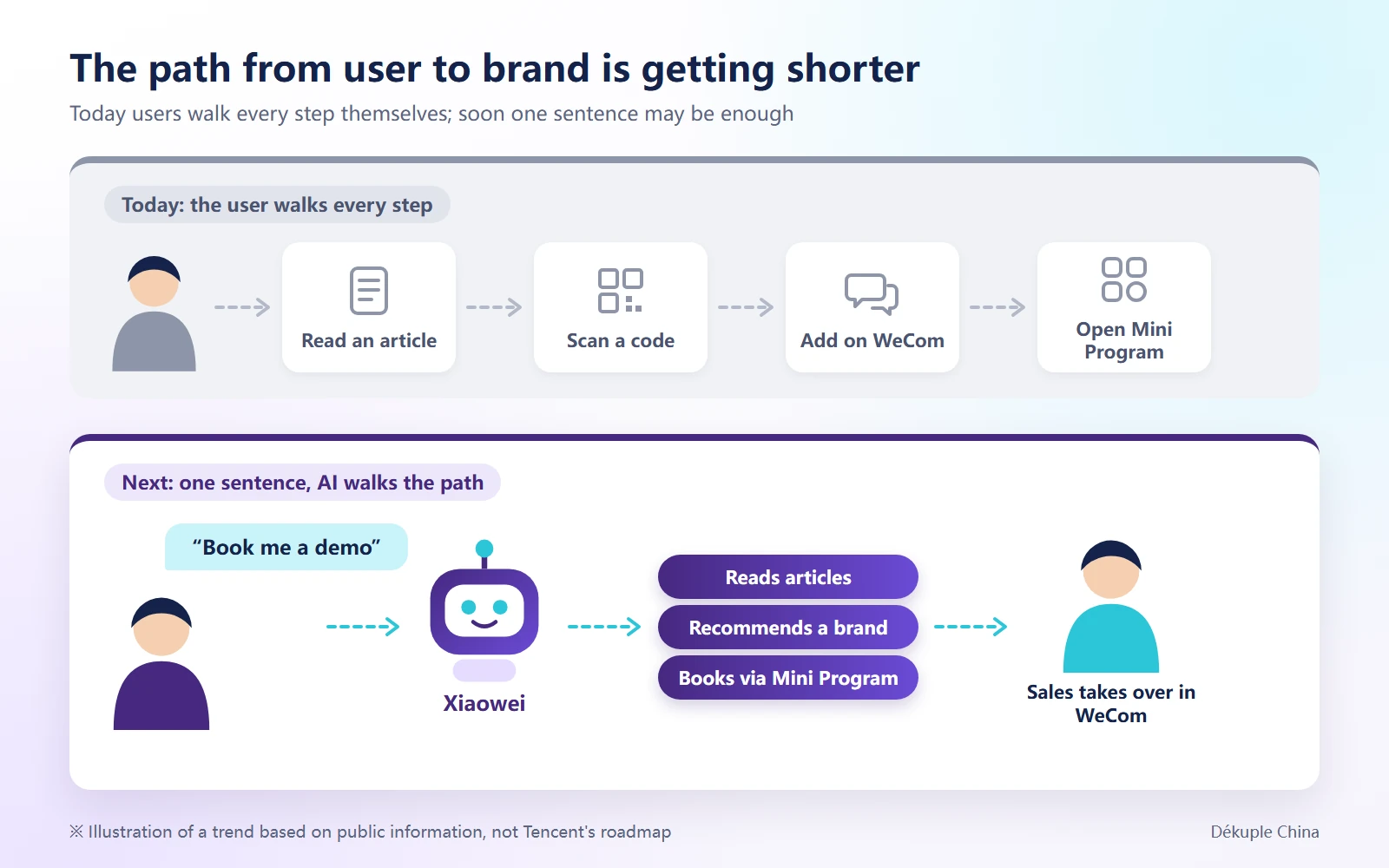
The path between the four roles gets shorter. Today a user reads an article, scans a code, adds a WeCom contact and opens a Mini Program, one step at a time. Soon a user may ask one question, and AI reads the article, recommends the brand, opens the Mini Program to book, and hands over to a salesperson in WeCom. We described the same trend in Personal AI agents: is GEO over?: as AI acts for users, brands need to be found, chosen and able to get the job done.
What international brands and B2B companies should prepare now
- Check your Mini Program's AI settings. If you have a Mini Program, look at the options on its "AI capabilities" page and make frequent services such as lookups, bookings and lead forms callable first.
- Treat the Official Account as a citable knowledge base. Pick the questions customers ask most and answer them in clear, data-backed articles with a conclusion, published on your website too.
- Give Channels videos full text. State the topic in the title, explain the product and use case in the description and subtitles, and pair key videos with an article.
- Clean up WeCom data. Use one tagging system and record each lead's source and stage, as groundwork for AI-assisted sales. For the system side, see our SCRM and marketing automation.
- Measure what AI changes. Beyond reads and contacts, track visits from AI search, Mini Program calls and lead quality. AI recommendations can be monitored with Brand Pulse.
For day-to-day Official Account and Channels work, see our social media management.
Conclusion
WeChat in 2027 won't be rebuilt from scratch; Official Accounts, Channels, WeCom and Mini Programs keep clear roles. What changes is a new AI layer between users and brands that reads content, picks brands and calls services for the user. Brands need to be readable, findable and able to deliver for that layer: content AI can cite, Mini Programs AI can call, WeCom data that can be put to work. The earlier you prepare, the better placed you are when Xiaowei opens to everyone.
Key Data & Sources
| Data | Value | Source |
|---|---|---|
| Tencent Q3 results: building an AI technology base, core business steady (in Chinese) | 1.449bn combined MAU; Xiaowei test widening (19 Nov 2026) | Xinhua |
| WeChat AI is coming: developer guidelines published (in Chinese) | Two modes for Mini Programs to join WeChat AI (8 Jun 2026) | Sina Finance |
| Tencent tests AI assistant in WeChat in China to catch up with rivals | Xiaowei small-scale test and capabilities (22 Jun 2026) | CNBC |
| Tencent's AI office agent WorkBuddy connects with WeCom (in Chinese) | WeCom and WorkBuddy share accounts and work context (14 Oct 2026) | Caixin |
| Tencent: WeChat's DeepSeek integration only uses public information such as Official Accounts (in Chinese) | WeChat Search AI mode draws on Official Account content (Feb 2025) | The Paper |
FAQ
What is Xiaowei in WeChat?
Xiaowei is a native AI agent Tencent has been testing inside WeChat since June 2026. Users can ask it by text or voice to message friends or use Mini Programs to order food, book rides or make appointments. As of November 2026 the test is widening but it is not open to all users.
How can a brand's Mini Program be called by WeChat AI?
Under the guidelines the WeChat Open Platform published in June 2026, developers opt in on the "AI capabilities" page of the Mini Program admin, using an automatic or a development mode. Only Mini Programs that opt in and pass review can be recommended and called by WeChat AI.
Is an Official Account still worth running once AI agents arrive?
Yes, with a different goal. Articles are retrieved and cited by WeChat Search's AI mode and by Yuanbao, so they become sources for AI answers. Clear, data-backed articles with a conclusion are the most likely to be cited.
How should B2B companies prepare WeCom SCRM for AI?
Start with the data: consistent customer tags, recorded lead sources and stages, and tidy chat and follow-up records. That data becomes the context for AI-assisted sales; the cleaner it is, the more AI can help.