

Personal AI agents are coming. Will GEO stop working? Our view: rankings won't disappear, but how we measure them will change

Once personal agents hide their sources, GEO built on reverse-engineering citations weakens. But agents still search and compare, so brands that are indexed and cited by trusted sources are still chosen more often. Ranking stays; the measure shifts to visits, calls, leads and sales.
A video that sparked the debate
A video circulating among Chinese marketers makes a sharp claim: with personal agents such as ByteDance's "Xiaodou", the logic of GEO has been rewritten. Its main points:
- GEO so far has been "prompt reverse engineering": find the user's intent, then seed content and sources to match;
- personal agents no longer show their sources, so that reverse approach stops working;
- AI is shifting from chatting to completing tasks for the user, and the big platforms will tie users' context to their own ecosystems (ByteDance through advertising, Tencent through Mini Programs and transactions);
- companies should drop "GEO ranking" thinking and judge results by website visits, agent skill calls and sales.
A caveat: as we write, media reports say ByteDance's Xiaodou is still in internal testing, with launch timing and final form unconfirmed, and Tencent's personal agent work has only been reported through Yuanbao and a WeChat AI assistant. The video's author ends by saying everything he said may be wrong. So rather than argue about one product, back to the real question: if AI increasingly acts for users and doesn't say whom it relied on, do search and GEO still matter for brands?
Where we agree
1. GEO built on mass-produced advocacy articles will get harder. Our own tests already show it: the sources AI cites change heavily from month to month (see AI sources change every month), and DeepSeek and Doubao barely cite the same pages (see 703 EV SUV answers analysed). Gaming one model on one set of questions was never stable, and once citations are hidden, even proving it worked becomes hard.
2. Measurement must move closer to business results. Counting citations or positions in AI answers is too far from revenue. In how to measure GEO results we recommend four kinds of metrics, and the most important is the visits and leads AI brings.
3. Letting agents get things done will matter more. Our pieces on WorkBuddy's computer use and WorkBuddy's WeChat Pay AI card show AI moving from recommending to ordering and paying. Whether your forms are easy to fill, your product information is in text and your Mini Program can be called will decide whether an agent can complete a task for the user.
Where we disagree: ranking won't disappear
1. Not showing sources doesn't mean not needing them. To compare prices, shortlist suppliers or book a service, an agent first has to know what the options are and how they compare. That still comes from search indexes, authoritative websites, encyclopedias, media and platform data. As we explained in where the pages AI cites come from, AI retrieval leans heavily on search engine indexes. Hiding citations hides why a brand was chosen; it doesn't remove the reason. Brands that aren't indexed or mentioned by trusted sources will find it even harder to be chosen by agents.
2. SEO has been declared dead many times. Mobile search, voice search, featured snippets, zero-click search, social search: over 20-plus years, every new entry point came with predictions that SEO was finished. Each time, the entry point changed, but "your brand comes first when people look for an answer" stayed the most direct measure a brand has, and the easiest one for management to understand. An agent is another entry point. It still ranks its options; the ranking has simply moved from a results page to the agent's shortlist.
3. B2B purchasing won't be handed to agents overnight. Food delivery or cinema tickets can be one sentence to an AI. Industrial equipment, software and professional services involve several decision makers, technical evaluation, price comparison and compliance checks. Agents will do much of the early research and supplier screening, which is exactly where search and content work hardest.
4. Our own data: AI brings visits, not vanishing traffic. In this week's GA4 data for dekuple.cn, ChatGPT accounts for about 8% of sessions, roughly level with Google organic search, landing on our careers pages and GEO research articles. An AI recommendation still ends on a page that has to load, make sense and capture a lead.
What this means for brands: from watching rankings to watching results
Our advice to clients comes down to one line: keep working on rankings, but don't only watch rankings.
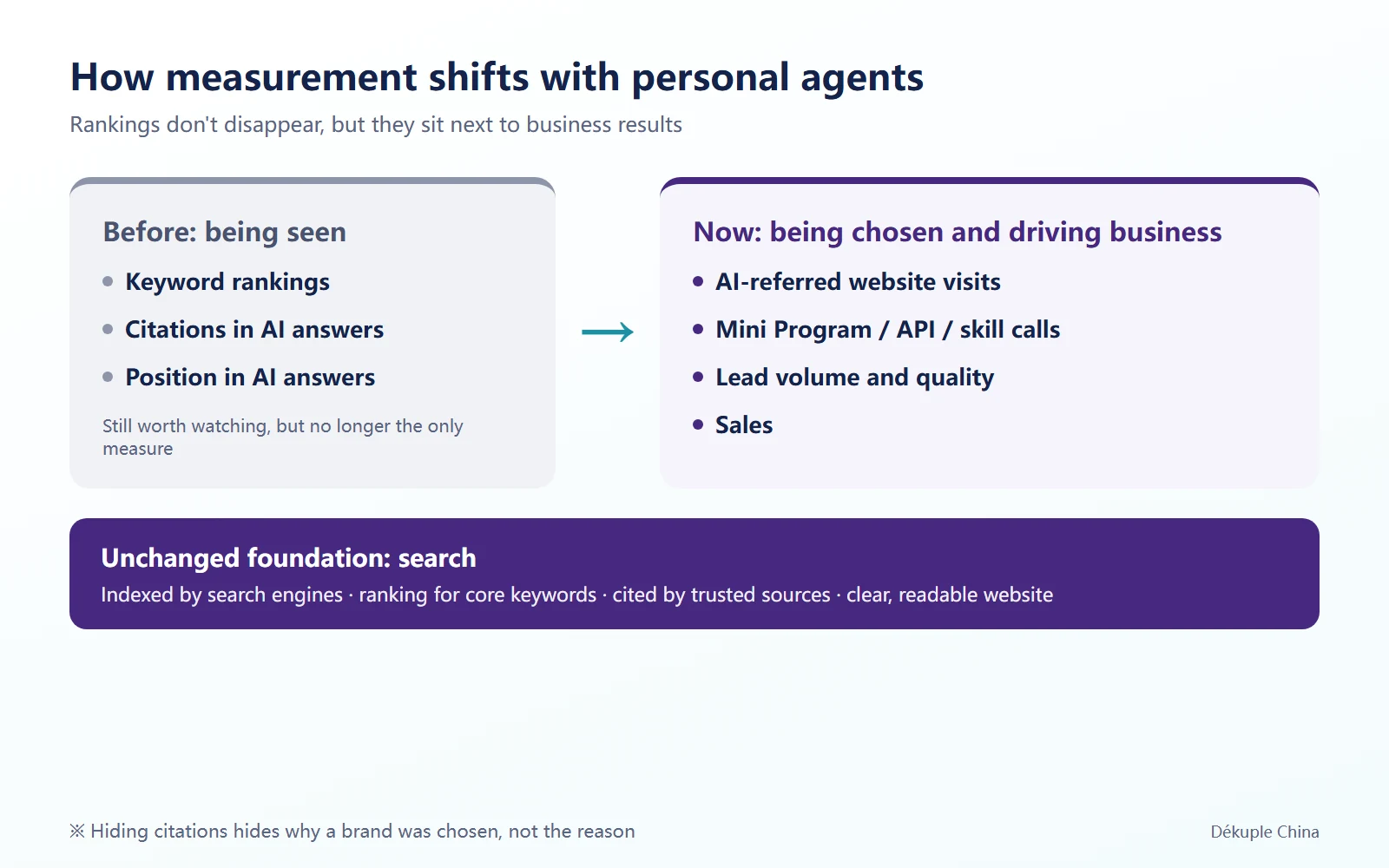
- Hold the search baseline. Being indexed properly by Baidu, Bing and Google and ranking for core keywords is the entry ticket in the agent era. See our China SEM and Baidu SEO agency service.
- Make the brand's context solid. Specifications, price ranges, service scope, cases and certifications, written in clear text and structured data on your website and trusted platforms. What an agent can't read won't be part of its judgement.
- Let agents get things done. Simple forms, key information outside images and PDFs, and where possible enquiries, bookings and orders available as callable Mini Programs or APIs.
- Upgrade measurement. Beyond rankings and AI visibility, track AI-referred visits, Mini Program and API calls, leads and sales. Tools such as Brand Pulse monitor AI recommendations, but the numbers need to sit next to business data.
- Catch agent-referred customers in your own channels. An agent can bring a customer to you; nurturing still runs through SCRM and marketing automation.
Conclusion
Personal agents will change how GEO is done, and will retire short-term tricks that only work when citations are visible. They won't change one thing: a brand needs to come first when users, or the AI acting for them, look for an answer. After more than 20 years of SEO, ranking is still the most direct measure a brand has; from here it extends from "what position" to "how often we were chosen and how much business that brought". Running the search baseline, brand context and business results as one GEO strategy is steadier than chasing any new buzzword.
For how Xiaowei, WeChat’s own personal agent, changes brand strategy inside WeChat, see WeChat in 2027: what the Xiaowei AI agent changes.
Key Data & Sources
| Data | Value | Source |
|---|---|---|
| ByteDance's Xiaodou is coming and Tencent is pushing on three fronts (in Chinese) | Xiaodou still in internal testing, no launch date | Woshipm |
| ByteDance and Tencent speed up AI development to catch Meta Muse (in Chinese) | Personal AI agent development | Huxiu |
FAQ
If personal agents hide their sources, is GEO still useful?
Yes, but the approach changes. Reverse-engineering sources for a single model will weaken. Being indexed, mentioned by trusted platforms and clearly readable on your own site still decides whether an agent chooses your brand.
Will personal agents replace SEO?
No. Agents still retrieve information before acting, and retrieval relies heavily on search indexes. SEO has been through many shifts in entry points over 20-plus years, and ranking remains the most direct measure for brands.
Which metrics should brands watch now?
Alongside keyword rankings and AI visibility, track AI-referred website visits, Mini Program or API calls, leads and sales, and judge visibility together with business results.
Do B2B companies need to prepare for personal agents now?
Start with the basics: make sure the website is indexed, product and service information is in text and structured data, and forms are easy to complete. Complex purchases won't be fully delegated soon, but early research and supplier screening will increasingly be done by AI.